"Vibe coding" taught solo founders they could ship software without writing every line themselves. "Vibe business" is the next step: running marketing, sales, and growth the same way — by directing AI agents instead of hiring a department. Here are the tools actually driving this in 2026, and where the model breaks if you skip marketing.
What "Vibe Business" Means in 2026
A vibe business is a company where a single operator directs AI agents through plain-language prompts to handle work traditionally split across engineering, marketing, and support. The clearest proof point: Maor Shlomo built Base44, an AI app-builder, almost entirely solo — roughly 90% of the code written with Claude, a team under 10 people, sold to Wix for $80 million cash six months after starting, per TechCrunch's June 18, 2025 report. That's the vibe coding half. The part most builders skip: Base44 still needed distribution and search visibility to get discovered — the "vibe marketing" half that gets bolted on too late, if at all.
Where Concat.pro Fits Into a Vibe Business Stack
The gap is specific: a founder vibe-codes a working product in a weekend, then has zero organic traffic, no idea how competitors rank, and no bandwidth to run SEO or outreach by hand. This is exactly where Concat.pro operates as the marketing layer of a vibe business:
- SEO/GEO Agent — audits your site and rewrites content for both classic search and AI answer engines (ChatGPT, Perplexity, AI Overviews), so a product built in days doesn't stay invisible for months.
- Rank — tracks where you and competitors sit in AI-generated answers and traditional SERPs, giving one operator the visibility a full SEO team would produce, without the headcount.
- Creator Agent — finds and vets relevant creators automatically, replacing the manual DM-and-spreadsheet outreach a one-person team doesn't have hours for.
- Ad Agent — generates and tests multiple ad variants from a single brief, applying the same "direct, don't do" logic vibe coding applies to engineering.
A founder running a Base44-style build sprint can pair it with the SEO/GEO Agent from week one instead of week twenty — the difference between compounding traffic and a launch that fades within a month.
Manual Workflow vs. AI-Run Vibe Business
| Function | Manual / Traditional Team | Vibe Business (AI Agent Stack) |
|---|---|---|
| Monthly cost | $80,000–$120,000 for a 10-person team | ~$300–$500 for an AI tool stack |
| SEO visibility | Weekly manual checks, agency retainer | Continuous tracking via Rank |
| Creator outreach | Spreadsheet + manual DMs, days per campaign | Automated discovery via Creator Agent |
| Ad creative testing | Designer + copywriter cycle, 1–2 variants/week | Several AI-generated variants same day |
| Time to first revenue signal | Weeks to months | Days |
That 95–98% cost gap is part of why Y Combinator's Winter 2025 batch skewed close to 75% AI-focused, with solo founders rising toward 15–20% of applicants, up from the usual 5–10%.
Best Tools for Vibe Coding the Product Layer
Before marketing matters, you need something to market:
- Claude Code / Claude — the model Maor Shlomo used to write most of Base44's codebase himself.
- Cursor — an AI-native IDE for editing a codebase through natural-language prompts instead of line-by-line changes.
- Replit Agent — spins up and deploys a working app from a single prompt.
- Lovable / Bolt — prompt-to-app builders aimed at non-engineers who need a fast prototype.
None of these solve distribution — that's a separate, often bigger, gap.
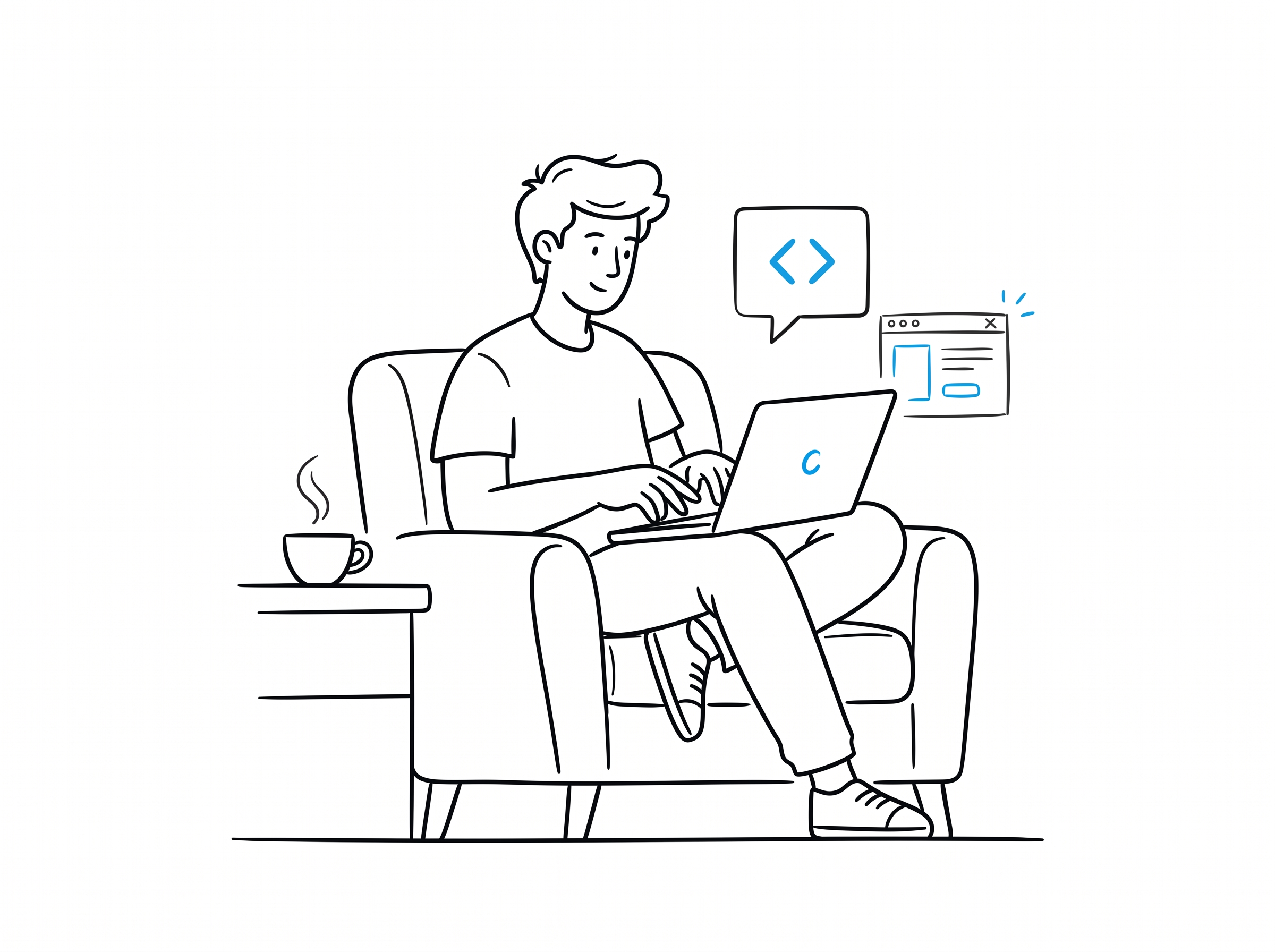
Best Tools for the Growth Side of a Vibe Business
Once the product exists, the job shifts to distribution, where most solo builders stall. A practical stack:
- Concat.pro SEO/GEO Agent + Rank for content and visibility, so traffic compounds instead of resetting every launch.
- Concat.pro Ad Agent for paid creative testing without a design team.
- Growth Rate Calculator to confirm week-over-week traction is accelerating before increasing spend.
- Automation layers (Make, n8n, Zapier) to connect these agents into a workflow that runs without daily manual work.
Concat Pro's AI growth marketing software breakdown covers how to sequence these tools, and the generative AI tools for growth roundup lists adjacent options worth testing.

Common Mistakes When Building a Vibe Business
- Shipping before tracking visibility. A launch-day traffic spike fades within weeks when no one set up rank tracking.
- Treating marketing as a task, not an agent. If engineering gets an AI agent but marketing gets a founder's leftover Friday, the business stays lopsided.
- Ignoring AI answer engines. Classic SEO alone misses discovery happening inside ChatGPT and AI Overviews — what a GEO-focused agent is built to catch.
- Skipping the numbers. Scaling ad spend without checking a growth rate calculator often burns cash on channels that were never compounding.
For more on cost-efficient tooling for small teams, see Concat Pro's best AI advertising tools for small business guide.
Watch: How a 1-Person AI Business Actually Runs
Sabrina Ramonov's walkthrough of a one-person AI-run business end to end is one of the clearer demonstrations of the vibe business model in practice.
The Bottom Line
The best tools for a vibe business aren't one app — they're a stack split across two jobs: building (Claude Code, Cursor, Replit) and growing (SEO/GEO Agent, Rank, Ad Agent, Creator Agent). Base44 proved the building half can happen in six months, solo. Whether a business built that fast survives its launch spike depends on whether the growth layer was running from day one.

References
- Concat Pro — SEO/GEO Agent and Rank, AI visibility tools for solo-run businesses.
- TechCrunch — 6-month-old, solo-owned vibe coder Base44 sells to Wix for $80M cash, June 18, 2025.
- Sabrina Ramonov — How To Start A 1-Person AI Business ($0 to $1M), YouTube.