Building software used to be the bottleneck for startups. Now it can happen in days. Vitalii Dodonov, cofounder of the creator-commerce startup Stan, spent 14 days in a London flat vibe-coding an AI content tool called Stanley, without writing a single line of code by hand. It hit $50,000 in monthly recurring revenue six weeks later.
That is the promise of vibe business: describe what you want in plain language, let AI agents write and ship the product, and move faster than traditional engineering teams can. But for startups, building fast is only half the problem. Investors and customers still need proof the growth is real and repeatable, which is where most vibe-coded startups stall.
Where Concat Pro Fits Into Vibe Business for Startups
Once a vibe-coded product is live, the work shifts from "can we build it" to "can we prove it, rank for it, and grow it on purpose." Concat Pro's SEO/GEO Agent generates SEO-friendly and AI-answer-ready articles tailored to each platform's tone, structure, and publishing format, then posts them in one click, so a lean founding team can get discovery content live without hiring a content team first. Rank gives founders curated rankings and benchmarks plus a creator-channel discovery tool, useful for scouting who is already talking to your target audience before you spend on outreach.
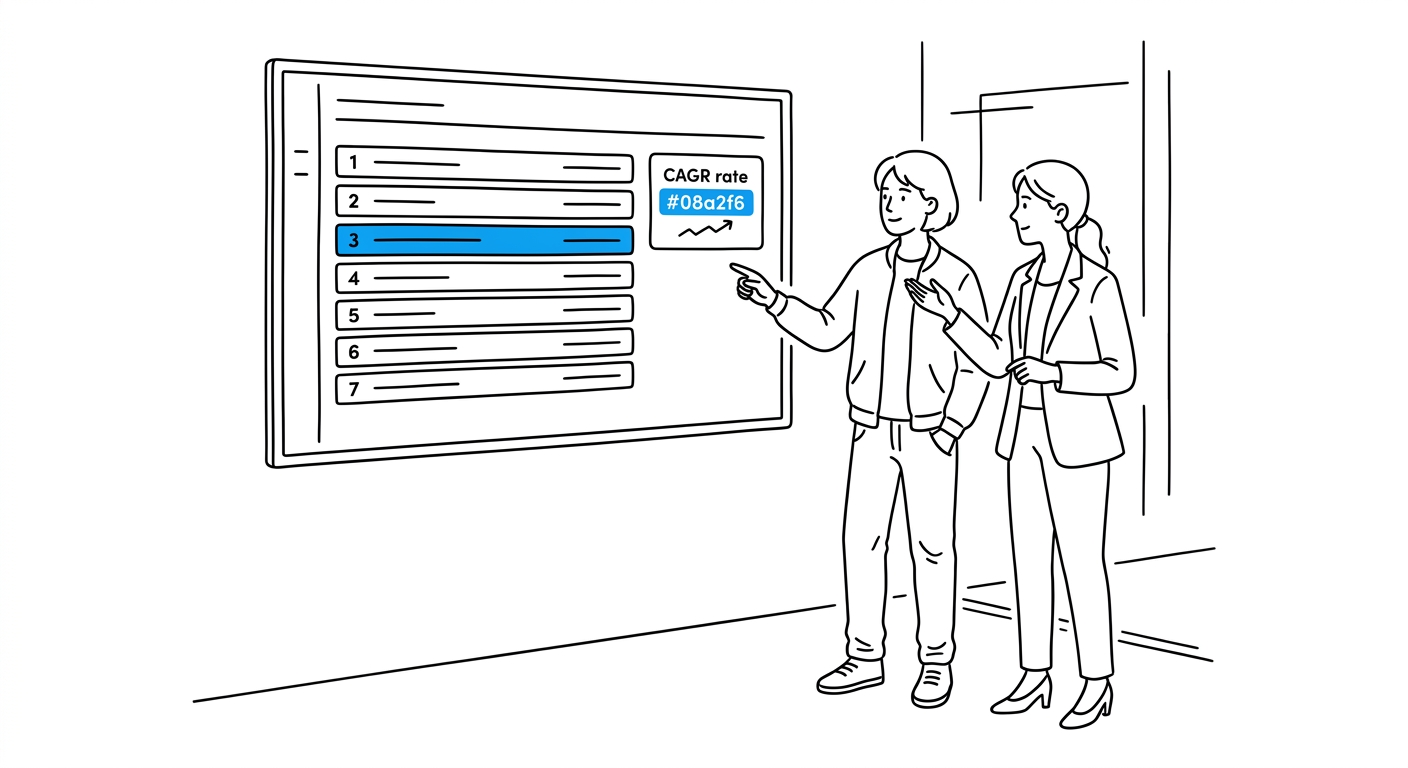
For the growth number that actually matters to investors, the Growth Rate Calculator measures growth between two values instantly: enter an initial value, a final value, and an optional number of periods, and it returns both the simple growth rate and CAGR, calculated as (End − Start) / Start × 100. It also shows benchmark ranges: early-stage SaaS MRR growth typically runs 15–25% per month, while SaaS ARR growth at Series A and beyond typically runs 20–50% per year. If your vibe-coded product is growing 10% per month, that is the fastest way to see how far you are from a fundable trajectory, rather than guessing from a dashboard screenshot.
What Vibe Business Actually Means for a Startup
Vibe business means using AI coding agents to build and launch a product mainly through natural-language prompts, then running the business around it with the same AI-first mindset. The shift is not hypothetical: the vibe coding market was valued at roughly $4.7 billion in 2025 and is projected to reach $12.3 billion by 2027, according to SeedScope's research on how startups are being built in 2026. Y Combinator reports AI-generated code in 95% of its latest batch's codebases, and Gartner projects 60% of all new software code will be AI-generated by the end of 2026.
For non-technical founders the effect is speed: 73% report shipping faster with AI tools, and teams using vibe coding complete tasks 51% faster than teams coding by hand. That is exactly what let Dodonov and his cofounder go from idea to paying customers in two weeks instead of two quarters.
How Stan Vibe-Coded Stanley to $3M ARR
Stan already runs a roughly $40 million-a-year creator-commerce business. Rather than staffing a full engineering team for a new content tool, Dodonov and his cofounder used Cursor to vibe-code Stanley, an AI "head of content" for creators, entirely through prompts. It launched to 250 paying customers on day one, crossed $50,000 in MRR within six weeks, and Stanley's two versions, one for LinkedIn and one for Instagram, now track roughly $3 million in combined ARR.
| Traditional build | Vibe-coded build | |
|---|---|---|
| Time to first version | Months | Days |
| Upfront cost | ~$100,000+ over 6 months | Roughly $500 in tooling |
| Team required | Engineers, PM, QA | Founder(s) + AI agent |
| Investor proof bar | Slower to reach, higher tolerance | Same bar, reached faster, less patience for gaps |
The Risks: Security Debt and Investor Scrutiny for Vibe Business Startups
Speed has a cost. SeedScope found that 45% of AI-generated code contains security vulnerabilities, 40% has exploitable bugs, and vibe-coded codebases churn 41% more than hand-written code. The cautionary case: Moltbook, an AI-agent social network launched in January 2026 whose founder claimed he "didn't write one line of code," was breached three days later, exposing 1.5 million API auth tokens, 35,000 emails, and plaintext credentials, traced to a basic misconfiguration.
Investors have adjusted accordingly. Because MVP cost dropped from roughly $100,000 over six months to a few hundred dollars in days, the runway founders once had to prove product-market fit compressed from around five years to closer to one — same proof bar, reached faster, with far less patience for unresolved gaps.

A Responsible Framework for Vibe Business Startups
- Ship the core loop first. Vibe-code the smallest version that lets a real customer pay you, not a demo.
- Instrument growth from day one. Track MRR and CAGR against real benchmarks, not vanity metrics.
- Audit before you scale distribution. Run a security review on anything public-facing before pushing traffic to it.
- Publish and rank on purpose. Use SEO/GEO content and benchmark tracking to earn discovery instead of hoping for it.
Common Mistakes to Avoid
- Treating "vibe-coded" as a synonym for "unaudited" and skipping security review before launch.
- Reporting raw revenue growth without normalizing it into MRR or CAGR against stage-appropriate benchmarks.
- Scaling spend before checking whether your target market or creators are even ranked or relevant.
- Assuming a fast build buys you a longer runway to prove product-market fit; it does not.
Watch: How To Get the Most Out of Vibe Coding
Y Combinator's Startup School has a direct session on this problem, presented by Tom Blomfield: "How To Get The Most Out Of Vibe Coding." It has drawn over 356,000 views and 8,800-plus likes.
Building Your Startup Growth Stack Around Vibe Business
Vibe coding solves the build problem, not the growth stack around it. Startups still need a repeatable way to pick tools: how to choose startup growth tools, how to build a startup growth stack, or the best AI tools for startups in 2026 as a starting point. Pair that stack with Rank for visibility benchmarking and the Growth Rate Calculator for honest growth math, and the "vibe" stays backed by numbers.
Bottom Line
Vibe business lets startups build in days what used to take months, and the case studies prove it can generate real revenue fast. But speed only compounds into a fundable company when it is paired with security discipline, honest growth measurement, and deliberate distribution. Build fast, then prove it with real numbers, not just a good demo.