15 Best Growth Navigate Startup Tools for 2026
Growth navigate startup tools are software products that help founders, growth marketers, and lean marketing teams decide what to measure, which growth work to prioritize, and how to execute it with less manual effort. A useful stack covers customer acquisition, CRM, website and product analytics, automation, collaboration, content, and retention without creating overlapping subscriptions. This guide compares 15 tools across those jobs, including integrated AI marketing software, CRM, web analytics, product analytics, SEO, email, social publishing, design, payments, and team operations. Use the comparison table, pricing notes, and startup stage recommendations to choose tools based on your current bottleneck, available budget, integration requirements, and the metric each product must improve.
Quick Answer: Choose Concat Pro for integrated AI marketing execution, HubSpot for CRM, Google Analytics 4 for website analytics, and PostHog for product analytics. Zapier is the best fit for connecting repetitive workflows, while Notion and Slack cover planning and communication. Start with free plans, then add paid software only when a measured bottleneck justifies it.

What Are Growth Navigate Startup Tools?
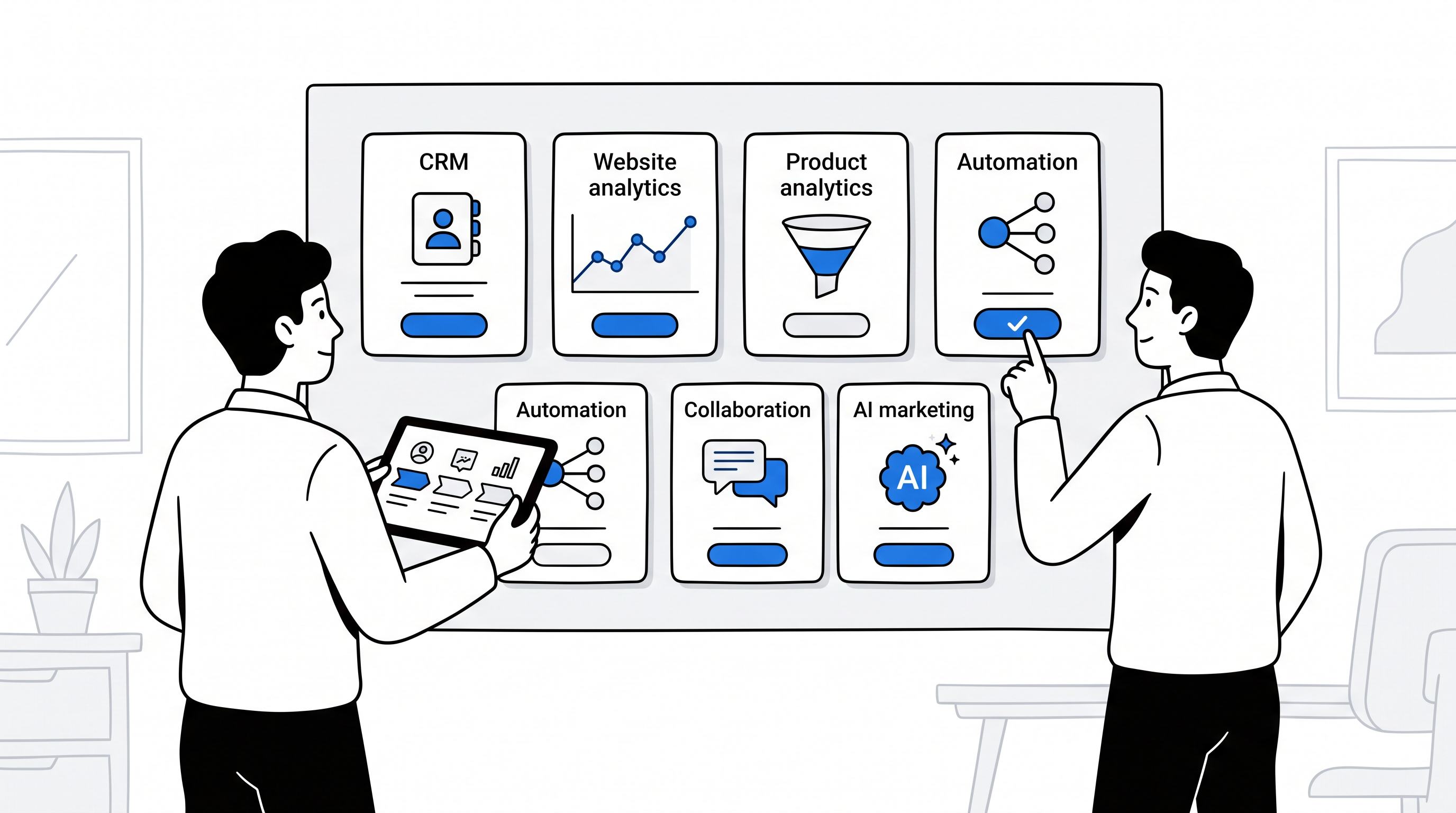
These products help a startup understand where growth is coming from, find friction in the customer journey, and coordinate the work needed to improve results. They are not a single software category. A complete but lean startup growth stack usually covers six jobs:
- Plan: organize research, priorities, experiments, and ownership.
- Acquire: improve search visibility, content, social distribution, and campaign execution.
- Convert: manage leads, landing page behavior, and sales follow up.
- Retain: communicate with customers and understand repeated product use.
- Measure: track website traffic, product events, search performance, and revenue.
- Automate: move reliable data and routine tasks between systems.
The goal is not to buy one product in every category immediately. It is to identify the most important constraint, choose one tool that addresses it, and set a measurable review date.
How We Compared the Tools
The 15 products below were selected for a clear growth job, relevance to startups, an accessible entry plan or transparent starting point, and usefulness at a defined company stage. Pricing reflects public vendor pages checked for this update. Vendors can change plans, usage limits, promotions, and regional rates, so verify the final amount before purchasing.
Growth Navigate Startup Tools Comparison: 15 Picks
| Tool | Best for | Public starting price | Best startup stage |
|---|---|---|---|
| Concat Pro | Integrated AI marketing execution across research, content, creator discovery, outreach, ads, and performance learning | Free plan; Grow is $170 per month | Early traction to scale |
| HubSpot | CRM, lead tracking, forms, and sales pipeline management | Free CRM; Starter Customer Platform from $10 per month | Early traction to scale |
| Google Analytics 4 | Website acquisition, engagement, and conversion reporting | Free; Analytics 360 pricing varies | All stages |
| PostHog | Product analytics, funnels, session replay, and experiments | Starts at $0; usage based after free allowances | Validation to scale |
| Google Search Console | Google search queries, indexing, clicks, and technical visibility | Free | All stages with a website |
| Semrush | SEO research, competitor analysis, and search visibility | Pro listed from $117.33 per month when billed annually | Early traction to scale |
| Hotjar | Heatmaps, recordings, surveys, and page experience research | Free plan; paid pricing varies | Validation to early traction |
| Zapier | No code workflow automation between apps | Free; Professional from $19.99 per month | Early traction to scale |
| Notion | Experiment planning, documentation, and team knowledge | Free plan; paid pricing varies | All stages |
| Slack | Team communication and operational alerts | Free; Pro pricing varies by billing terms | Early traction to scale |
| Brevo | Email campaigns, automation, and customer communication | Free; Starter from $9 per month | Early traction |
| Buffer | Simple social scheduling and publishing | Free; Essentials from $5 per channel per month when billed annually | Validation to early traction |
| Canva | Fast visual production for social, content, and sales materials | Free; Pro pricing varies by region and billing cycle | All stages |
| Stripe | Online payments, subscriptions, and revenue collection | No standard monthly fee; 2.9% plus 30 cents per successful US domestic card transaction | Validation to scale |
| Mixpanel | Funnels, cohorts, retention, and product behavior analysis | Starts at $0; paid usage pricing varies | Early traction to scale |
Pricing was checked against the linked official pages. Taxes, add ons, event volume, contacts, seats, channels, and annual billing can change the total cost.
The Best Tool for Each Growth Job
Best integrated AI marketing platform: Concat Pro
Concat Pro is the strongest fit when a lean team wants one operating layer for market insights, brand context, SEO and GEO content, creator discovery, outreach, ads, and performance feedback. Its public pricing includes a free plan and a $170 per month Grow plan. It complements analytics and CRM software rather than replacing the underlying website, product, or sales data systems.
Best CRM: HubSpot
HubSpot is a practical starting CRM for teams that need one record for contacts, forms, conversations, and deals. The free CRM supports initial pipeline discipline, while paid plans add broader marketing, sales, and service capabilities. Confirm which hub, contact allowance, and seat structure you need before upgrading.
Best website analytics: Google Analytics 4
GA4 is the default choice for measuring traffic sources, website engagement, and configured conversion events without a software fee. It is most useful when the team has a written measurement plan. Install only the events tied to decisions, and pair it with Search Console for query and indexing data.
Best product analytics: PostHog
PostHog is well suited to product led startups that need funnels, session replay, feature flags, and experiments in one product analytics environment. Its usage based model lets small teams begin at $0, but event volume can affect future cost. Mixpanel is a strong alternative when the main need is focused funnel, cohort, and retention analysis.
Best SEO research: Semrush
Semrush is the specialist choice for teams ready to invest in keyword research, competitor analysis, and search visibility. Google Search Console should come first because it reports first party Google search data at no cost. Add Semrush when the team needs market and competitor intelligence that Search Console does not provide.
Best behavior research: Hotjar
Hotjar helps teams see where visitors click, scroll, hesitate, or abandon a page. Use it to investigate a specific conversion question, not to collect recordings without a research plan. Review privacy and consent requirements before enabling recordings or surveys.
Best workflow automation: Zapier
Zapier connects tools when a process is stable enough to automate. Useful examples include sending a qualified form submission to HubSpot, notifying Slack when an important event occurs, or adding approved campaign data to Notion. Do not automate a workflow that still changes every week.
Best team operations: Notion and Slack
Notion is best for durable knowledge, experiment backlogs, briefs, and decision records. Slack is best for current conversations and alerts. Define what belongs in each system so decisions do not disappear into chat history.
Best email and social distribution: Brevo and Buffer
Brevo gives early teams an accessible entry point for email campaigns and automation. Buffer is a simple choice for scheduling content across social channels. Neither replaces positioning or channel strategy, but both can reduce execution overhead once a repeatable publishing process exists.
Best creative production: Canva
Canva is useful for quickly producing social graphics, presentation assets, and simple campaign creative. Keep shared templates, approved colors, and brand rules in place so production speed does not create visual inconsistency.
Best payments infrastructure: Stripe
Stripe gives startups a direct way to collect payments and subscriptions, which makes it part of the growth measurement stack as well as the finance stack. Connect revenue events to your analytics and CRM systems so the team optimizes for paid conversion, not just leads or clicks.
Which Tools Fit Each Startup Stage?
Stage 1: Problem validation and pre revenue
Start with Notion for research and experiments, Slack if the team needs shared communication, Canva for basic assets, GA4 and Search Console for a live website, and Stripe when you are ready to charge. Add PostHog or Hotjar only when product or page behavior creates a specific unanswered question.
At this stage, the best tools for startup growth are usually free and narrowly configured. The objective is learning, not automation.
Stage 2: Early traction and a repeatable channel
Add HubSpot when leads and customer conversations no longer fit in a spreadsheet. Add Brevo for lifecycle email, Buffer for repeatable social distribution, and Zapier for stable handoffs. Use PostHog or Mixpanel when activation and retention matter more than raw traffic.
If budget is the main constraint, compare this stack with our guide to affordable growth tools for startups.
Stage 3: Scaling acquisition and operations
Add Semrush when organic search is an accountable channel and competitor research affects the content roadmap. Consider Concat Pro when research, content, creator outreach, advertising, and performance learning require coordinated execution across a lean marketing team. Upgrade analytics, CRM, and automation plans only when actual volume or governance needs exceed the entry tier.
For deeper evaluation of automation at this stage, see AI tools for startup growth.
How to Choose Your Startup Growth Stack
- Name the bottleneck. Choose one problem such as low qualified traffic, weak activation, lost leads, slow campaign production, or poor retention.
- Set one success metric. Examples include qualified signups, activation rate, sales cycle length, retained accounts, or revenue per visitor.
- Audit existing coverage. Confirm that a current product cannot solve the problem before adding another subscription.
- Check integrations and data ownership. Verify how the tool sends data to your CRM, analytics, warehouse, or reporting workflow. Review export access and privacy controls.
- Calculate total cost. Include seats, contacts, channels, events, automation tasks, implementation time, and annual commitments.
- Pilot with a deadline. Record a baseline, run the product long enough to observe the target metric, and set a decision date.
- Remove overlap. If two tools perform the same core job, keep the one with better adoption, cleaner data, and a clearer contribution to growth.
Use the free Growth Rate Calculator to document a baseline before adding software. For examples of how other companies match categories to bottlenecks, read what tools startups use for growth.
Common Stack Mistakes
- Buying suites before defining the problem. A broad feature list does not guarantee that the team will use the product.
- Tracking activity instead of outcomes. Published posts, automated tasks, and captured events matter only when they improve a business metric.
- Paying twice for the same capability. CRM, analytics, email, and automation products often have overlapping features.
- Ignoring implementation cost. A free product can still be expensive if setup, governance, and maintenance consume team time.
- Adding AI without clean inputs. AI tools for startup growth depend on reliable brand context, customer data, and performance signals.
- Keeping tools after the stage changes. A useful validation tool can become an unnecessary expense once the business needs stronger governance or integration.
FAQ
What are growth navigate startup tools?
They are software products that help startups plan, execute, measure, and improve customer acquisition, conversion, retention, and operations. The term covers categories such as CRM, analytics, SEO, automation, collaboration, content, and payments.
Which tool should an early startup choose first?
Choose the product tied to the most important unanswered question. For website acquisition, begin with GA4 and Search Console. For product behavior, choose PostHog or Mixpanel. For lead management, start with HubSpot. For integrated AI marketing execution, consider Concat Pro once multiple marketing workflows need coordination.
How much should a startup spend on growth software?
There is no universal amount. Begin with free plans where they meet the requirement, then calculate the total cost of seats, contacts, events, channels, and automation volume. Approve a paid tool only when its expected value and target metric are documented.
What is the difference between website analytics and product analytics?
Website analytics tools such as GA4 explain traffic acquisition and on site conversion paths. Product analytics tools such as PostHog and Mixpanel focus on events, funnels, cohorts, activation, and retention inside the product. Many software startups need both, but they should assign each tool a distinct measurement role.
When should a startup add automation?
Add automation after a workflow is repeatable, its inputs are reliable, and a person can explain every step. Automating an unstable process creates faster errors rather than useful scale.
Should a startup choose an all in one platform or specialist tools?
Use specialist tools when one function requires depth, such as product analytics or payments. Use an integrated platform when coordination across several marketing functions is the larger bottleneck. Many effective stacks combine both approaches.
Conclusion: Build a Focused Startup Growth Stack
The right growth navigate startup tools stack is the smallest set of products that gives your team reliable data, clear ownership, and faster execution at its current stage. Start with free measurement and collaboration tools, add CRM and automation when traction creates repeatable work, then invest in specialist SEO, product analytics, or integrated AI marketing software when the related channel becomes accountable for growth. Review pricing and product limits on the official pages before purchasing, measure one business outcome per tool, and remove subscriptions that no longer solve a current bottleneck.
References
- Concat Pro — AI marketing execution platform, product capabilities, and plans
- HubSpot CRM — CRM capabilities and startup pricing
- Google Analytics — Website analytics capabilities and availability