Most "how to start a bookkeeping business" guides give you a checklist: get a license, pick software, find clients. What they skip is what actually happens after you open your doors — and the U.S. market is big enough that skipping it is expensive. Payroll and bookkeeping services are an $80.9 billion industry in 2026, growing 3.8% this year alone, and roughly 33 million small businesses in the U.S. need someone to keep their books straight. The opportunity is real. So is the failure rate among people who launch with a generic checklist and no plan for pricing, visibility, or growth.
This framework is built from three bookkeepers who actually did it, with real numbers attached: a solo operator who scaled to roughly $40,000 in monthly recurring revenue, a firm owner who grew from 11 clients to 108 in five years, and a local firm that turned SEO investment into hundreds of qualified leads. Use their playbooks as your operating plan, not just your to-do list.

Phase 1: Pick Your Lane Before You Pick a Client
The bookkeepers who scale fastest narrow their service line early instead of trying to be a full-service accounting shop on day one. Zach Pasquariello built Harrisburg Bookkeeping around bookkeeping only — no payroll, no tax prep, no CFO work — so every hour he sold was a repeatable, teachable process. Juliana Ramirez of JR Bookkeeping in Ventura, CA niched into small businesses under 10 employees, which let her build one onboarding playbook instead of ten. Decide who you serve (industry, business size, or service depth) before you decide how you price.
Phase 2: Price for Two Revenue Streams, Not One
New bookkeepers usually think in monthly retainers only. The real money often sits in cleanup work. Hourly rates for bookkeeping run roughly $25–$90/hour depending on experience, while monthly retainers typically land between $300 and $2,000 per client depending on transaction volume. But cleanup projects — fixing a year of tangled books — pay differently: Pasquariello billed one client $16,000 for roughly 20 hours of cleanup work, and members of his peer network closed three separate $5,000 cleanup projects in a single week. Build your price sheet around both: a recurring retainer for ongoing work, and a premium flat-fee for cleanup and catch-up projects.
Phase 3: Get Found Before You Pitch
Referrals and visibility beat cold outreach every time. Ramirez started in April 2012 with 11 clients handed off by a former employer, then grew to 28 by year-end through referrals alone — roughly two new clients a month. Her single biggest client source, five years in, is still CPA referral partnerships, supplemented by networking events and a monthly client newsletter that keeps her name in front of past clients and their accountants. By hiring her first employee in year two and reaching 108 clients and six staff by year five, she proved that a referral engine compounds if you feed it consistently instead of treating outreach as a one-time launch task.
But referrals only carry you so far if nobody can find you online when they search. An accounting and bookkeeping firm that invested in technical SEO, on-page content, and local Google Business Profile optimization generated 358 web form submissions in 12 months at an average cost per lead of $46.82 — proof that "get found locally" is a measurable growth channel, not a nice-to-have. This is exactly the gap Concat Pro's SEO/GEO Agent is built to close for service businesses that don't have a marketing team: it builds and monitors the local and AI-search visibility work most solo bookkeepers never get around to doing themselves.

Phase 4: Track Growth Like a Business, Not a Side Hustle
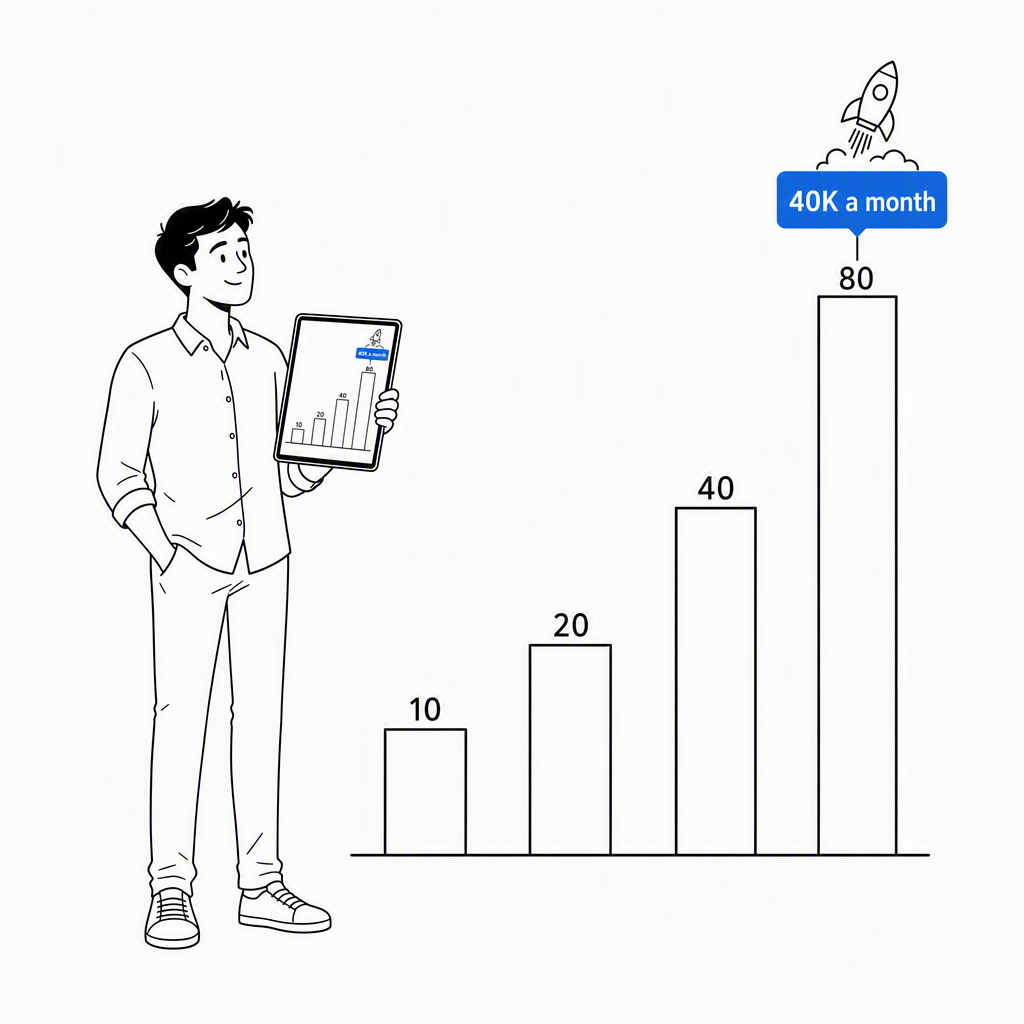
Pasquariello's client count didn't grow by accident — it roughly doubled year over year: 10 clients, then 20, then 40, then 80, at an average retainer near $500/month, putting him near $40,000 in monthly recurring revenue at 80 clients. That kind of trajectory only happens when you treat the business itself like a client: track client count, average retainer, and churn monthly, and set a written target for each quarter instead of just reacting to whoever calls next.
Before you commit to a niche or a local market, run the math on how many businesses like your target client actually exist nearby — Concat Pro's Market Size Calculator is a fast way to sanity-check that a niche can actually support your growth targets before you spend months building a client base that tops out too early. Then confirm the economics hold up: the Margin Calculator helps you check that your retainer and cleanup pricing still leaves real profit after software, contractor, and admin costs, so growth in client count actually turns into growth in take-home income.
Manual vs. AI-Assisted Bookkeeping Operations
| Task | Manual Approach | AI-Assisted Approach |
|---|---|---|
| Client onboarding | Manual intake forms, back-and-forth emails | Automated intake + document collection workflows |
| Transaction categorization | Line-by-line manual review each month | AI-assisted categorization with bookkeeper review |
| Invoicing & payment reminders | Manual tracking in spreadsheets | Automated recurring invoices and reminders |
| Local search visibility | Occasional manual directory updates | Continuously monitored SEO/GEO Agent optimization |
| Growth tracking & reporting | Ad hoc spreadsheet updates | Dashboard tracking clients, MRR, and churn in real time |
Common Mistakes to Avoid
- Pricing purely by the hour with no retainer floor, which caps your income to your calendar
- Skipping a signed engagement letter, which invites scope creep on every account
- Serving every type of client instead of a defined niche, which slows referrals and repeat playbooks
- Ignoring local SEO and Google Business Profile, leaving inbound leads on the table
- Never revisiting pricing as client complexity grows, quietly shrinking your margin
Watch: Starting a Bookkeeping Business in 2026
For a step-by-step walkthrough from a bookkeeper who scaled past 80 clients, watch How To Start a Bookkeeping Business in 2026 (Part 1) — published January 2026 with over 15,000 views.
References
- Concat Pro — SEO/GEO Agent, Market Size Calculator, Margin Calculator
- Firm of the Future (Intuit) — ProAdvisor Profile: Juliana Ramirez
- Online Visibility Pros — Accountant & Bookkeeping SEO Case Study