How to Start a CPA Business: The Growth Playbook Behind $600K Solo Practices
Passing the CPA exam qualifies you to do the work. It does nothing to get you clients. That gap — technical competence on one side, an empty pipeline on the other — is where most new CPA practices stall in year one. Angel Zhen learned this the hard way in 2020. He left a $90,000 salary after his father passed away during tax season, with no clients, no safety net, and no plan beyond "I'm good at this." Today he runs a solo, zero-employee, fully virtual practice generating more than $600,000 a year and serving 300+ clients nationwide. The technical skill was never the bottleneck. Visibility and structure were.
This guide breaks starting a CPA business into four phases, in the order operators actually run them, with real numbers from firms that made the jump from "good accountant" to "growing practice."
Phase 1: Get Licensed and Structured Before You Spend a Dollar on Marketing
Before any client-facing work, lock down the foundation: active CPA license in your state, an LLC or PLLC (check your state's rules on professional entities), professional liability (malpractice) insurance, an IRS EFIN if you'll e-file, and a PTIN if you'll prepare returns for pay. Pick your core software stack now — practice management, a tax engine, a secure client portal — because retrofitting these after you have 40 clients is painful. This phase costs a few thousand dollars, not tens of thousands. Resist the urge to lease office space or hire staff before you have recurring revenue.
Phase 2: Pick a Lane and Price for Value, Not Time
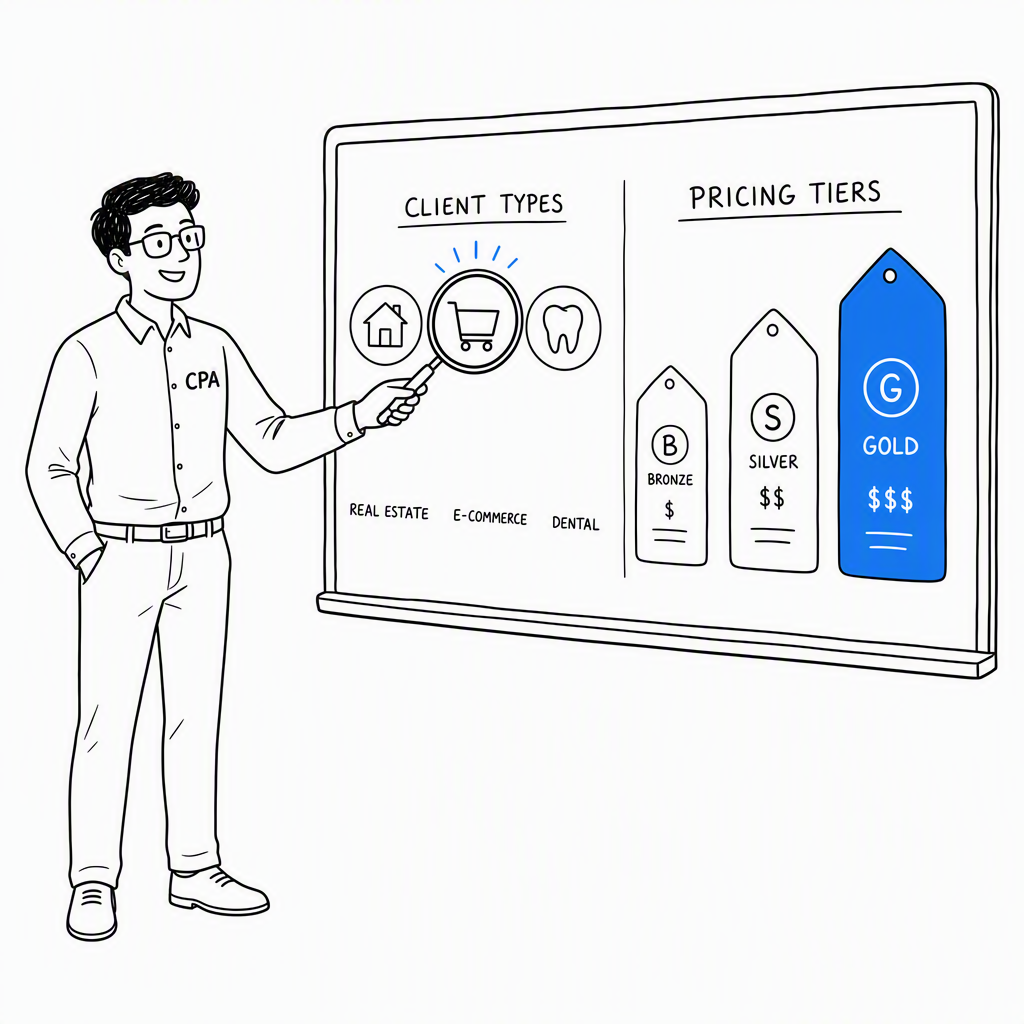
Generalist CPA firms compete with every other generalist in a 50-mile radius. Firms that niche — real estate investors, e-commerce sellers, dental practices, solopreneurs — compete with almost no one, because deep specialization is rare and clients pay for someone who's clearly seen their exact problem before. Zhen's practice targets real estate investors and high-income solopreneurs specifically; it's a large part of why he can charge premium fees as a solo operator instead of racing to the bottom on $300 returns.
Pricing follows the same logic. Move from hourly billing to fixed-fee or tiered packages (bronze/silver/gold), and lead pricing conversations with the cost of getting something wrong, not your hourly rate. Zhen closed one engagement at a flat $8,000 fee by first walking the client through the tax consequences of a misaligned S-corp structure — the fee became secondary once the client understood the stakes.
Phase 3: Build Visibility Before You Pitch Anyone
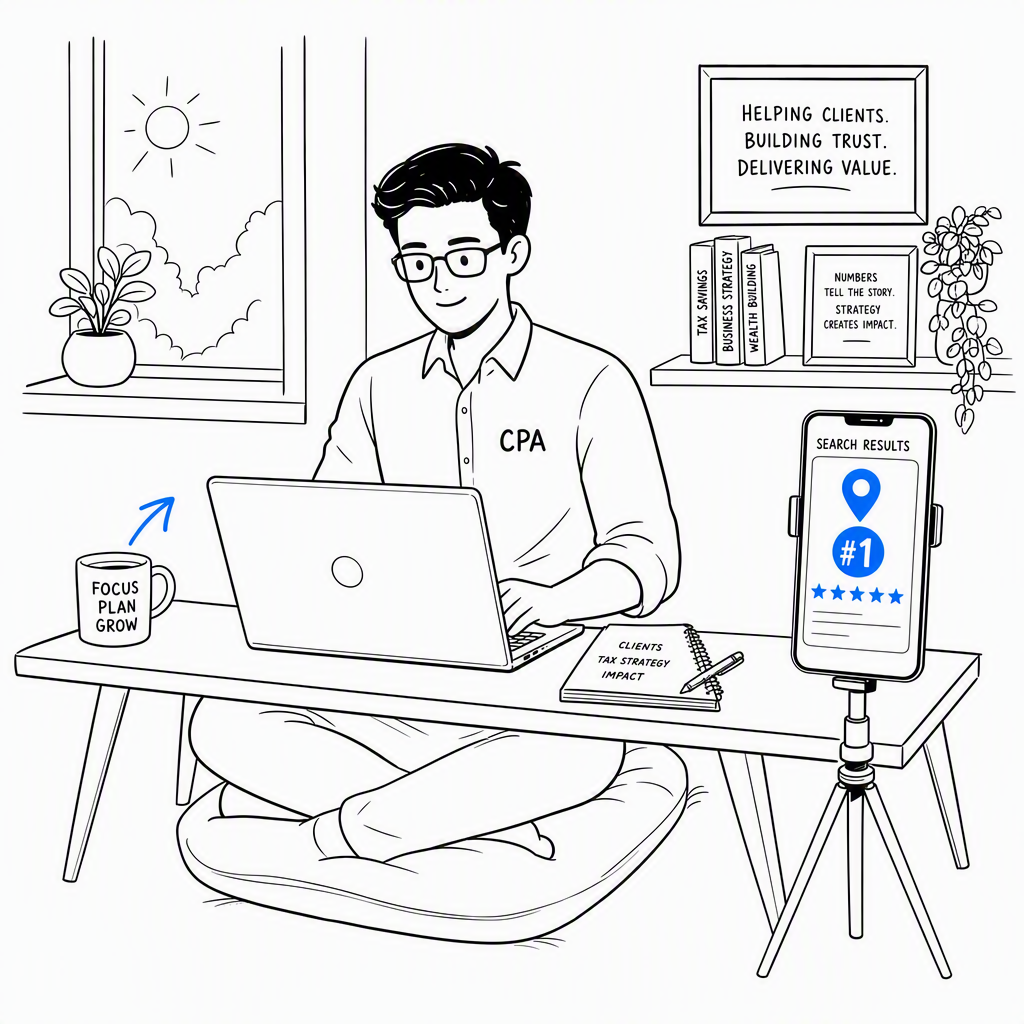
This is the phase most technically excellent CPAs skip, and it's the one with the clearest data behind it. A referral today rarely leads straight to a phone call — it leads to a Google search. If what shows up is a bare-bones site with no reviews, the referral goes cold.
Zhen stacked three visibility signals deliberately: ranking #1 on Google when someone searches "CPA in Pasadena," collecting 100+ five-star reviews, and publishing on LinkedIn to build a reputation among peers and prospects before they ever call. A 30-year Midwest CPA firm that had relied entirely on its founder's personal network took the same approach when that founder began planning retirement — a rebuilt, SEO-optimized site plus ongoing content marketing took organic traffic from 300-500 visitors a month in 2020 to 2,000-3,000 a month in 2025, generated 950 form submissions from a series of guides and case studies, and produced nearly $1 million in new, mostly recurring revenue. Last year, 79% of that firm's new leads came from marketing, not referrals.
Phase 4: Track Growth Like a Business, Not a Practice
Once clients are coming in, run the numbers monthly: cost per lead, close rate, effective hourly rate per client (not just revenue — a big engagement that eats 20 hours can be less profitable than a small one that takes two), and client lifetime value. Firms that skip this step keep taking on undervalued work because "the client is nice" or "we've always done it this way," and profitability quietly erodes even as the client list grows.
Manual vs. AI-Native Growth Workflow
| Task | Manual Approach | AI-Native Approach |
|---|---|---|
| Google Business Profile optimization | Update posts/photos occasionally, hope for reviews | Automated review requests, structured post cadence, local keyword monitoring |
| Service/location landing pages | Write one generic "services" page | Generate niche- and location-specific pages at scale, each targeting real search intent |
| Review generation | Ask happy clients occasionally, inconsistently | Automated post-engagement review requests triggered by workflow, tracked systematically |
| AI search visibility (GEO) | No visibility into how ChatGPT/AI Overviews describe your firm | Structured content and schema built specifically for AI citation, monitored over time |
| Case study/content production | One blog post every few months, if ever | Continuous case-study and content output from real client outcomes |
Common Mistakes That Stall New CPA Practices
- Underpricing to feel "safe." Cheap prices attract cheap, high-friction clients and make premium positioning almost impossible to reclaim later.
- Treating the website as a brochure. A site with no SEO, no local optimization, and no reviews doesn't get found — no matter how good the CPA behind it is.
- Taking every client that calls. Volume without a defined niche keeps you a generalist competing on price forever.
- Skipping the runway calculation. Divide savings by monthly minimum costs before going full-time; firms built on a one-month runway make panicked, bad pricing decisions.
- No system for reviews or referrals. Waiting passively for word-of-mouth means the loudest discount-seekers, not your best clients, generate most of your referrals.
Where Concat Pro Fits
Getting found is the recurring theme across every case above — not tax expertise, not credentials, visibility. Concat Pro's SEO/GEO Agent builds and monitors the local SEO and AI-search presence (Google Business Profile signals, service pages, structured content) that turned a struggling Yellow Pages advertiser into a firm with a 145.7% jump in organic search leads. Before you set pricing tiers, run the numbers through the Growth Rate Calculator and Margin Calculator to see what client volume and pricing actually need to look like to hit your revenue target — the same math Zhen and the firms above ran before scaling.
Watch: How a $5M Firm Owner Would Build Visibility Today
"How I Built My Accounting Firm to $5M and What I'd Do Differently" by Jason On Firms (24,760 views) — see Step 8, "Be Highly Visible," for a blunt breakdown of why most accountants hide their best work behind closed doors instead of letting it attract the next client.
References
- Concat Pro — SEO/GEO Agent, Growth Rate Calculator, Margin Calculator
- Angel Zhen, CPA, "4 ways sole practitioners can set themselves apart," Journal of Accountancy (AICPA), June 2026
- Innovaxis Marketing, CPA Firm Case Study