Mrs. Lia ran her home-baked cake business the way most small businesses do: orders came in through WhatsApp, stock lived in her head, and payment proof was a screenshot buried in a chat thread. On a busy weekend she lost hours just re-typing the same order into a notebook.
That is the real starting point for "vibe business" thinking. It isn't about founders shipping a SaaS app to raise money. It's about an existing small business using AI-agent tools to build software it could never have afforded to commission -- then using the right growth tools to make that software pay for itself.
Where Concat Pro Fits Into Vibe Business for Small Business
Building the app is only half the job. Once a small business has a working order or booking tool, two questions follow: who else should we be reaching, and is this actually worth the time we're putting in?
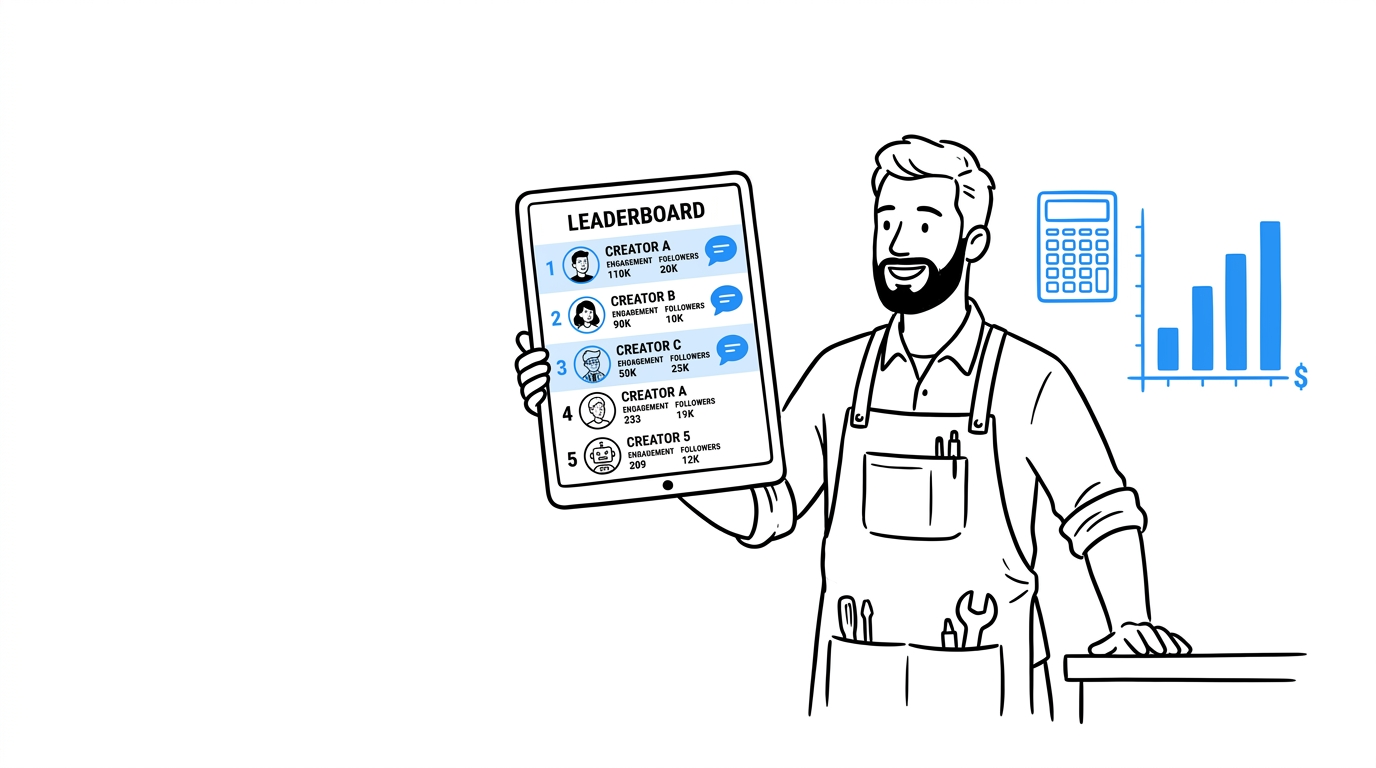
Concat Pro's Rank surfaces top influencers and channels across industries and platforms, giving a small business a starting point for creator research -- a way to find relevant local or niche creators to reach with a new storefront, instead of guessing. A bakery that just went digital doesn't need a media agency; it needs a shortlist of five relevant food or community accounts worth a direct message.
The second question -- is this worth it -- is where the Margin Calculator earns its place. Enter the monthly running cost and a proposed price, and it shows margin at 10, 50, and 200 customers. For a vibe-coded ordering app, that turns "we saved a few hours a week" into a number the owner can act on before deciding to expand.
What "Vibe Business" Actually Means for a Small Business
Vibe coding -- describing what you want in plain language and letting an AI agent write the code -- has moved past personal projects. For a small business, it means the owner or a hired freelancer builds a working tool without a development budget, then keeps adjusting it by asking for changes in plain English, not filing a change request with a dev shop.
The difference from the startup version is stakes and scope. A small business doesn't need a scalable multi-tenant platform. It needs one working screen -- an order form, a booking calendar, an inventory count -- small, specific, and shipped in days, not quarters.

Real Numbers: The Mrs. Lia's Kitchen Case
Freelance builder Ridzuan Amani documented exactly this in a Medium case study published in October 2025. Using Lovable AI and Supabase for the build, and Gemini/NotebookLM to plan it, he shipped a customer storefront and an owner dashboard for Mrs. Lia's cake business in one weekend, for $0 to $25 total.
Customers could see live stock, pay by QR code, and upload a receipt in under two minutes. The owner got a password-protected dashboard: every order visible instantly, one-click payment verification, one-click WhatsApp confirmation, and real-time stock control.
Her own reaction, quoted in the case study: "the 'wow' moment was the WhatsApp feature... that's a game-changer." The measured result was 3-4 hours a week of admin reclaimed -- about 208 hours a year. At even a modest RM25 (~$5.30) hourly admin rate, that's roughly RM 5,200 ($1,100) in avoided cost annually, against a build that cost less than a dinner out.
Manual vs. AI-Assisted: What Actually Changes
| Task | Manual (WhatsApp/Spreadsheet) | Vibe-Built App |
|---|---|---|
| Taking an order | Retype from chat into notebook | Customer submits form directly |
| Verifying payment | Scroll for screenshot, check memory | One-click verification |
| Checking stock | Guess or ask around | Real-time count on screen |
| Confirming to customer | Type a reply manually | One-click WhatsApp template |
| Weekly time cost | 3-4 hours | Minutes |
Watch: Building a Small-Business App With AI Agents
For a walkthrough -- an AI co-builder plus no-code blocks assembling a working small-business tool -- see Mikey No Code's August 2026 video, "How to Vibe Code Your Business App in 2026."
A 4-Step Starting Framework
- Name the one repeated headache -- usually order intake, booking, or payment tracking. Don't fix everything at once.
- Describe it to an AI builder in plain language and get a working first version within a day, not a spec document.
- Run the WhatsApp-to-app handoff with real customers for one to two weeks before retiring the old process.
- Check the math and find your audience. Run the numbers through a margin calculator at your realistic volume, and use Rank to shortlist a handful of relevant creators worth reaching directly.
Common Mistakes
- Building the whole business at once instead of the single process costing the most hours.
- Skipping the parallel-run period -- keep the old WhatsApp flow available while customers adjust.
- Never checking the margin -- know the real dollar value before scaling spend on a new tool.
- Reaching the wrong audience -- a short, relevant creator list converts better than a long generic one.
Vibe business for small business isn't about becoming a tech startup. It's a home bakery, a repair shop, or a neighborhood service closing the gap between "stuck retyping WhatsApp orders" and "a real system," for the cost of a weekend and a few dollars of AI credits. For more on where AI fits into everyday operations, see Concat Pro's guides on AI tools for small business and generative AI for small business, or read the vibe business explainer for the underlying concept.
References
- Concat Pro — Rank: Creator & Channel Discovery and Margin Calculator
- Ridzuan Amani, "How I Built a $0 App to Automate a Friend's Local Business in a Weekend Using Lovable AI," Medium, Oct 16, 2025 — medium.com/@procarerooted
- Mikey No Code, "How to Vibe Code Your Business App in 2026," YouTube, Aug 2026 — youtube.com/watch?v=2KUmMIRTPYs