A vibe business — a company where AI agents handle most of the idea-to-revenue loop, from writing code to shipping features — sounds like it should replace every other path to launching a product. It doesn't. It replaces one specific, expensive step: getting a working first version in front of real users. Everything that happens after that — hardening the code, hiring engineers, and proving growth is real — still runs on the same rules it always did.
This is the actual decision founders face: not "should I use AI," but which combination of AI tools, freelancers, agencies, and manual work gets them from zero to a defensible business fastest, without paying twice for the same mistake.
Where Concat Pro Fits in the Vibe Business vs Alternatives Decision
Whichever path you pick, two questions repeat at every stage: is this actually growing, and who do I reach once it is? Concat Pro answers both without guessing.
Rank publishes curated leaderboards of top-tier creators and channels by platform and niche — YouTube, Instagram, TikTok, X. A solo founder who just shipped a vibe-coded MVP with zero marketing budget can pull a niche's Top 50 list the same day and start outreach, instead of paying an agency thousands for creator research before demand is even proven. The Growth Rate Calculator takes two real numbers — last period's signups and this period's — and returns a simple growth rate or CAGR, benchmarked against reference bands like early-stage SaaS MRR (15–25%/month) or e-commerce revenue (10–20%/year). That's the number that tells you if a vibe-built MVP is actually gaining traction or just riding a demo-day spike. Once a product needs a real audit before wider launch, the SEO/GEO Agent and Website Agent run the technical and content checks a growth team would otherwise pay an agency to do manually. None of this replaces the build decision below — it just keeps you from making that decision on vibes alone.
Vibe Business vs Alternatives: Comparing the Real Options
| Path | Upfront cost | Time to first version | Who owns the risk |
|---|---|---|---|
| AI tools solo (vibe business) | $0–$100/month | Days | You — code review is on you |
| Freelancer/agency hardening sprint | $5,000–$15,000 | 2–4 weeks | Split — you validated, they secure it |
| Full agency build from scratch | $20,000–$200,000+ | 2–4 months | Agency, but so is the bill |
| Manual/no-code without AI orchestration | Low cash, high hours | Weeks–months | You, mostly in time |
The numbers come from Máté Várkonyi's 2026 breakdown of vibe coding versus hiring an agency, and they line up with a separate ChopDawg analysis that puts a "solid MVP" agency engagement at $50,000–$150,000. Both sources land on the same practical rule: AI tools are for validating a wedge cheaply, not for skipping the parts of software development that determine whether the business survives contact with real users and real traffic.
The security gap is the part vibe-business advocates gloss over. Veracode's 2025 research found 45% of AI-generated code contains exploitable vulnerabilities, and a separate 470-pull-request study cited by ChopDawg found AI-co-authored code carries 1.7x more major issues, with security problems 2.74x more common. Only 33% of developers say they trust AI-generated code outright, even though 84% use or plan to use it.
The Sequencing Framework: Validate, Review, Harden
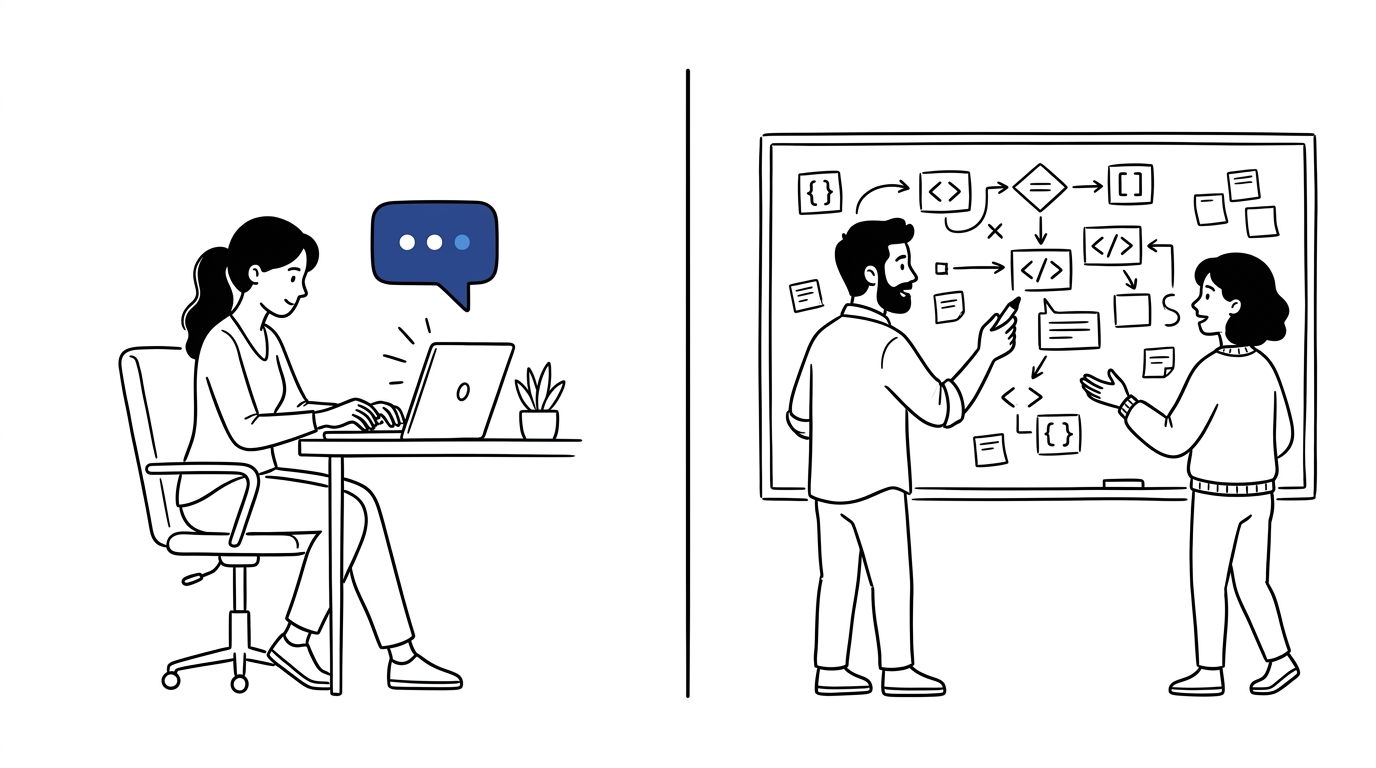
- Validate cheap. Build the smallest version with AI tools — chat-based coding assistants, no-code layers — and get it in front of real users. Anything nabbed a $100M valuation just two weeks after hitting $2M ARR by moving this fast, per TechCrunch's September 2025 reporting. Speed here is the entire point; polish is not.
- Review at the moment of truth. Before you take payments, store user data, or run paid traffic, get a professional code review. This is the $5,000–$15,000 hardening-sprint step, and it's cheaper than every alternative if you skip it and something breaks in production.
- Harden or rebuild with real distribution behind it. Once growth is verified — not assumed — bring in an agency or in-house engineers for the parts that need to survive scale: auth, payments, uptime. This is also when the Growth Rate Calculator confirms the trajectory is real, and Rank turns up the creators and channels worth reaching once distribution — not just the build — is the bottleneck.

Common Mistakes When Choosing Between Vibe Business and Alternatives
- Treating a $0–100/month AI stack as a permanent substitute for engineering. It's a validation budget, not an operating budget.
- Skipping code review at the moment of truth because the demo looked finished. A working demo and production-safe code are not the same claim.
- Hiring a full agency before demand is proven, paying $20,000+ to build something nobody asked for. Validate first with the guides in ai-tools-for-small-business, then scale the build.
- Ignoring the security stats — 45% vulnerable AI code, 1.7x more major issues — until a leaked key or auth gap forces an emergency, more expensive fix.
- Confusing traffic with growth. Run real numbers through the Growth Rate Calculator before deciding the vibe-built version is "working." Our growth-automation-tools roundup covers what to automate once it is.
Bottom Line
Vibe business and its alternatives aren't competing philosophies — they're sequential tools. Use AI to validate for days and dollars, not months and tens of thousands. Bring in professional review at the moment real users, real payments, or real traffic show up. And measure every step with real numbers using the Growth Rate Calculator, then use Rank to find the creators worth reaching before you spend on the next stage.
References
- Concat Pro — Rank, Growth Rate Calculator, and the SEO/GEO Agent
- Máté Várkonyi, "Vibe Coding vs Hiring an Agency: What Founders Actually Need in 2026," VeryCreatives, Aug 24, 2026 — verycreatives.com/blog/vibe-coding-vs-hiring-an-agency
- Marina Temkin, "Vibe-coding startup Anything nabs a $100M valuation after hitting $2M ARR in its first two weeks," TechCrunch, Sept 29, 2025 — techcrunch.com/2025/09/29/vibe-coding-startup-anything-nabs-a-100m-valuation-after-hitting-2m-arr-in-its-first-two-weeks