AI advertising for ecommerce is the use of machine learning to decide which products to promote, how much budget to give each one, and which creative to show which shopper — updated continuously instead of weekly. For a growth team running Meta, Google Shopping, and PMax at once, that shift replaces manual bid caps and static creative sets with a system that reallocates spend and tests variants every day. Two capabilities drive most of the gain: product-level budget scoring and automated creative personalization. Below is how each works, what it costs to get wrong, and where Concat Pro fits into the stack.
How Concat Pro Powers AI Advertising for Ecommerce
Most ecommerce ad accounts break at the handoff between the product feed and the campaign. New SKUs launch, but budget and creative are still built for last quarter's bestsellers. Concat Pro's Ad Agent closes that gap: it syncs your live product feed into channel-ready campaigns automatically, so new SKUs enter paid rotation without a manual mapping step. It then reallocates budget across funnel stages daily based on conversion signal, and iterates creative variants per audience segment, killing underperformers instead of letting them run out the week. That is the exact mechanism behind the two case studies below — daily reallocation and per-segment creative testing — just applied at a different vendor.

Before you commit budget to any of this, use Concat Pro's CTR calculator to model what a creative-testing lift would actually be worth at your current spend, and check Rank to see which creators and channels are already active in your category — a useful input when you're deciding which audience segments deserve their own AI-generated creative variant.
Two Forces Behind AI Advertising for Ecommerce: Budget Scoring and Creative Personalization
AI advertising for ecommerce succeeds or fails on two separate jobs. The first is deciding which products get budget. The second is deciding which creative each segment sees. Doing one without the other caps the upside — you can have a perfectly scored product with a generic ad, or a great ad pointed at the wrong SKU.
| Task | Manual approach | AI approach |
|---|---|---|
| Product budget allocation | Rules based on last month's revenue | Predictive scoring updated daily from live signal |
| Creative testing | 3-4 variants per quarter, reviewed manually | Dozens of variants per segment, auto-killed on underperformance |
| Localization | One creative set for all regions | City- or segment-specific variants generated automatically |
| Attribution | Spreadsheet stitched from platform dashboards | Unified dashboard across channels |
Case Studies: AI Advertising for Ecommerce in Action
River Island (UK fashion retailer) with smec. River Island's Performance Max campaigns were falling into what smec calls the "Hero/Zombie" trap: a handful of products absorbed all the budget while the rest sat idle, because Google's own historical bidding data couldn't tell PMax which new or slow-moving SKUs deserved a chance. smec's Campaign Orchestrator and SmartScore AI replaced that with predictive product scoring — using a "neighbourhood effect" to estimate a new product's potential from similar items, rather than waiting for its own sales history to accumulate — combined with dynamic segmentation and automated budget shifts. Over a four-month stretch, Kidswear grew revenue 34% with orders up 30% and ROAS up 19.2%; Womenswear grew revenue 33% with orders up 32% and ROAS up 15%. "We now make data-driven decisions and continuously grow revenue while maintaining strong ROAS," said Elvis Mugera, Paid Media Lead at River Island.
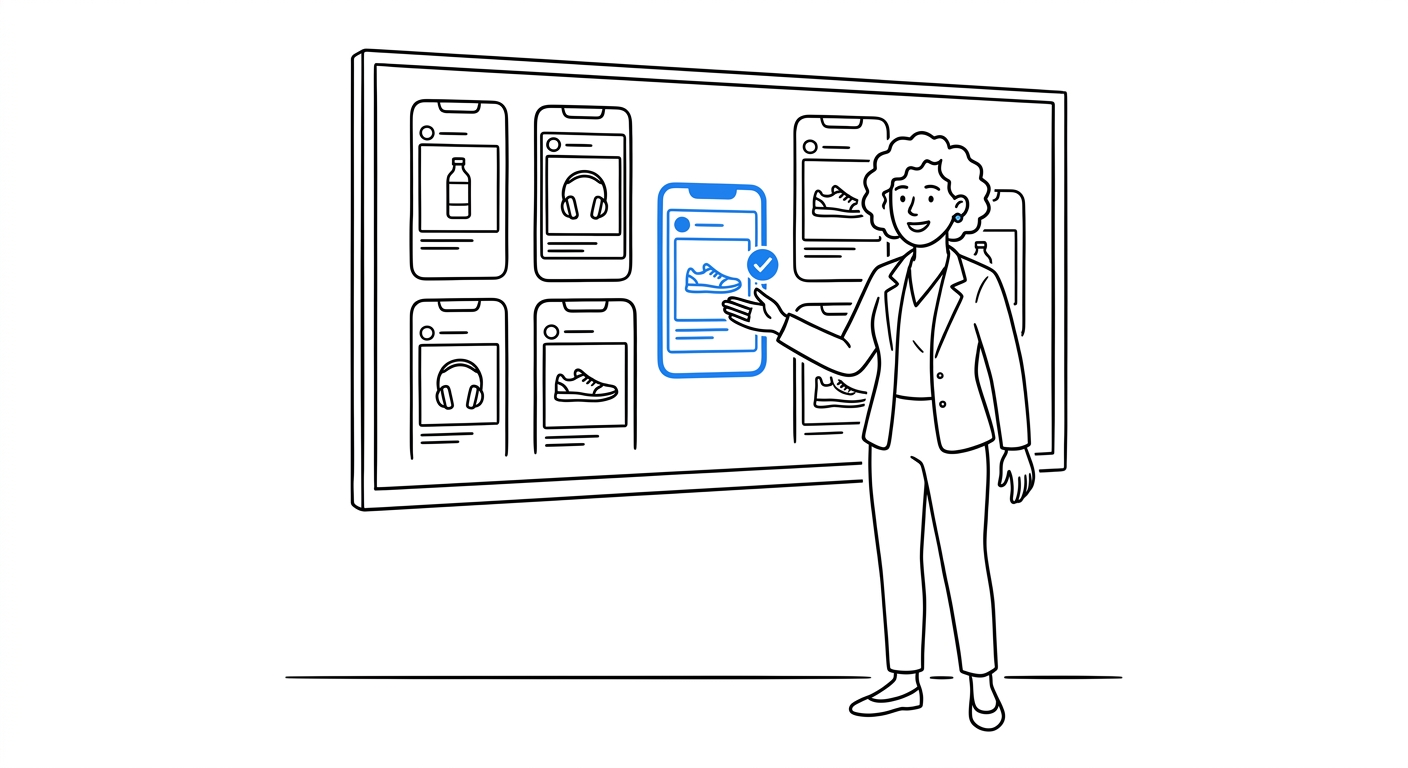
Covetear (Australian jewelry brand) with Born Techies. Covetear's ads performed well near its Gold Coast home base but flattened everywhere else — generic creative, no city-level targeting, and no clean view of which channel drove which sale. Born Techies rebuilt the account around AI-driven dynamic creative testing that automatically evaluates and optimizes variants by location, behavior, and device, layered with hyper-local campaigns for Sydney, Melbourne, Brisbane, Perth, and Adelaide, plus a unified attribution dashboard. Qualified metro traffic rose 74% and ad conversions rose 2.6x, taking Covetear from a regional label to a nationally recognized brand.
Both cases lean on the same two forces from the table above — one AI system scoring products for budget, the other generating and testing creative per segment — just run by two different vendors on two different platforms. For a walkthrough of the creative-generation side specifically, this recent tutorial on building AI ad creative for an ecommerce product is a useful watch:
Common Mistakes in AI Advertising for Ecommerce
- Feeding AI a stale product feed. Predictive scoring is only as good as the feed. If new SKUs, price changes, or out-of-stock flags take a day to sync, the model is optimizing against yesterday's catalog.
- Testing creative without segmenting the audience first. A dozen variants shown to the same broad audience is not personalization — it is noise. Segment first, then let AI generate variants per segment.
- Setting budget rules once and leaving them. Manual budget caps set at campaign launch calcify. Daily reallocation only helps if it is actually running daily, not reviewed monthly.
- Skipping the ROI check before scaling. Run the projected lift through a calculator before committing more spend — a 2.6x conversion uplift on a small metro budget is a different decision than the same multiple on a national one.
- Ignoring attribution across channels. If Meta, Google, and any AI ad platform each report their own numbers, you can't tell which system is actually driving the lift.

Where This Fits Your Stack
If you're building this out, two related reads are worth a look: AI for Ecommerce covers the broader set of AI workflows beyond ads, and Ecommerce Traffic breaks down the acquisition channels feeding these campaigns. If you're earlier in the stack-building process, Growth Tools for Ecommerce Brands is a good starting checklist.
References
- Concat Pro — Ad Agent
- smec (Smarter Ecommerce) — River Island Named 2026 Drum Awards Finalist for 34% Revenue Growth via AI-Driven Product Scoring
- Born Techies — How AI Ad Optimization Took an Australian Jewelry Brand from Local to National: 2.6x Conversions Achieved