A support ticket queue grows in a straight line with order volume. Headcount doesn't. That gap is why "AI customer service for ecommerce" has moved from a nice-to-have to a line item growth teams actually budget for — but most of what's written about it is vague ("automate your support!") with no verifiable before-and-after. Below is what actually happened at two named ecommerce brands that deployed it, what it costs to get wrong, and where a visibility-and-ROI tool like Concat Pro fits before you sign a contract.
Where Concat Pro Fits Before You Deploy AI Customer Service for Ecommerce
Concat Pro doesn't build the chatbot that answers your customers' questions — that's not what it does, and this article won't pretend otherwise. What it does is answer the two questions you need settled before you buy or configure any AI customer service for ecommerce: are you even visible to the AI systems shoppers are asking, and what is the deployment actually worth in dollars.
Concat's SEO/GEO Agent produces AI-answer-ready content — FAQ pages, return-policy pages, sizing guides — structured so Google and AI chat assistants like ChatGPT and Perplexity can actually parse and cite them. If a shopper asks an AI shopping assistant a policy question and your FAQ isn't written in a citable format, the assistant answers with a competitor's page instead, no matter how fast your own support chatbot resolves tickets once someone lands on your site.
Concat Rank solves a different problem, once your AI customer service program has real before-and-after numbers worth talking about: it surfaces top influencers and channels across industries and platforms, giving you a starting point for creator research and helping you find relevant people to reach with your results — instead of manually scrolling LinkedIn and TikTok for the right voices to feature a support-automation win.
Once those two pieces are in place, run your numbers through the Growth Rate Calculator. Plug in your current ticket volume, average handle time, and support headcount cost, and model what automating a realistic share of tickets is worth per month before you commit budget to a vendor. That single step is what separates the brands below — who scaled support without a corresponding headcount increase — from teams that bought a chatbot and never measured whether it paid for itself.

Real Growth Cases: AI Customer Service for Ecommerce in Action
Orthofeet, the largest orthopedic footwear ecommerce brand in the US, deployed Gorgias's AI Agent across email and chat. Within two months, the AI Agent was automating 56% of all support tickets — order status, sizing questions, and return requests — without adding a single support hire. The speed shift was the more dramatic number: average email first-response time dropped from 24 hours to 35 seconds, a 99.96% reduction, and chat first-response time dropped from roughly 3 minutes to 13 seconds (a 92.8% reduction). Orthofeet's support team kept its existing headcount while the brand maintained double-digit year-over-year revenue growth — proof that the automation absorbed volume growth instead of the team absorbing it through overtime. (Source: Gorgias)
A second, industry-wide data point confirms this isn't a one-brand fluke. Gorgias's State of Conversational Commerce 2026 report, based on more than 350 million conversations across its ecommerce customer base, found that shoppers who chat with an AI or human agent before buying convert at a 154% higher rate than shoppers who don't, and 79% of surveyed brands said AI-powered conversational commerce directly increased sales — not just support efficiency. AI customer service for ecommerce, in other words, is no longer purely a cost-center play; brands are measuring it as a revenue channel. (Source: Gorgias 2026 report)
For a broader look at how AI-driven conversational tools are reshaping the ecommerce funnel end to end, this recent walkthrough is worth watching:
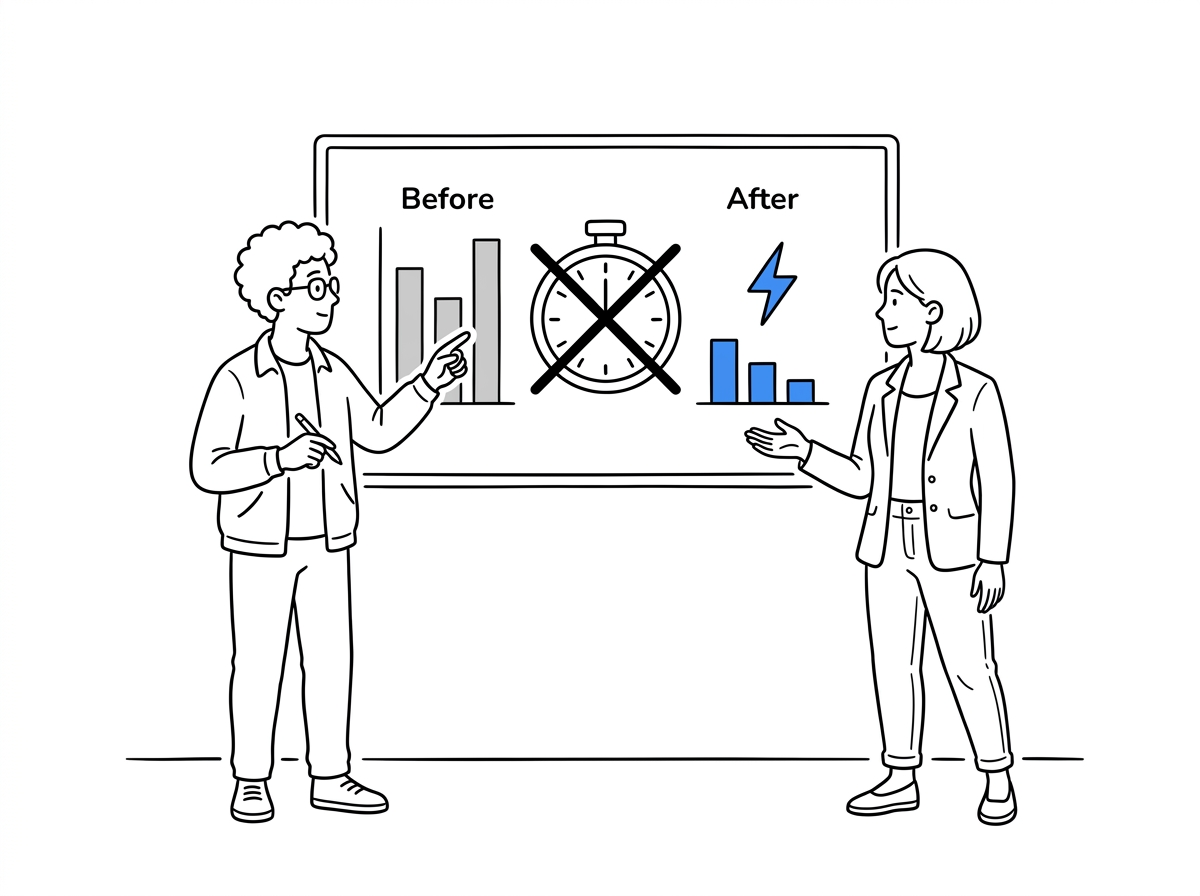
Manual Support vs. AI Customer Service for Ecommerce
| Task | Manual Approach | AI-Assisted Approach |
|---|---|---|
| Email first response | Hours, queue-dependent (Orthofeet: 24 hrs before) | Seconds (Orthofeet: 35 sec after) |
| Order status / sizing FAQs | Human agent answers each one individually | AI Agent resolves the majority automatically |
| Scaling with order volume | Requires proportional headcount growth | Absorbs volume growth at flat headcount |
| Pre-purchase product questions | Answered if/when an agent is available | AI chat answers instantly, lifting conversion |
| Measuring ROI | Rarely tracked against a real baseline | Growth Rate Calculator models ticket-cost savings and revenue lift before rollout |
Common Mistakes in AI Customer Service for Ecommerce Rollouts
- Automating before diagnosing volume. Orthofeet automated the specific ticket types that scale with order volume (status, sizing, returns) first — not every conversation type at once.
- Skipping the AI-citation check. An AI shopping assistant can't recommend a return policy or sizing guide it can't parse. Fix that with the SEO/GEO Agent before you polish the support chatbot itself.
- Treating it as pure cost-cutting. The 154% conversion lift from pre-purchase chat shows AI customer service for ecommerce is also a sales channel — brands that only measure ticket deflection miss half the ROI.
- No dollar baseline before rollout. "Response times feel faster" isn't a result. Run current ticket cost and volume through the Growth Rate Calculator so the after-number means something.
- Ignoring escalation paths. Orthofeet's 56% automation rate implies 44% still routes to humans — the fastest deployments keep a clear, fast handoff for anything the AI shouldn't resolve alone.
For related workflow breakdowns, Concat Pro's guide on AI for ecommerce customer acquisition covers how AI chat interactions feed acquisition math, and AI tools for customer acquisition walks through the missed-inquiry cost problem that AI customer service is built to close. If you're earlier in the funnel and want the broader AI adoption picture across ecommerce, AI in ecommerce examples rounds up additional verified cases with public metrics.

Getting Started
Run your FAQ and policy pages through the SEO/GEO Agent to confirm AI assistants can actually parse and cite them. Model the dollar value of automating your highest-volume ticket types with the Growth Rate Calculator. Then pick the specific ticket categories — not every conversation — to automate first, the way Orthofeet did. Measure response time and conversion before and after, the same two numbers that made Orthofeet's case verifiable instead of anecdotal.
References
- Concat Pro — SEO/GEO Agent, Growth Rate Calculator, and Rank
- Gorgias — Orthofeet Customer Story: 56% of tickets automated in 2 months, email response time cut from 24 hours to 35 seconds
- Gorgias — State of Conversational Commerce 2026: 350M+ conversations analyzed, 154% higher conversion for shoppers who chat, 79% of brands report AI conversational commerce increased sales