Your shop, salon, or service business needs a better way to run day-to-day operations, but you already have customers, staff, and revenue to protect. You cannot afford three months of downtime while a new system gets built. This is the exact spot where "vibe business" tools — AI app builders that turn a plain-language request into a working internal tool — get pitched as the default answer. But an AI builder is not the only option, and for an operating small business it is not automatically the right one.
This guide compares the four real paths a small business owner has: AI/no-code app builders, hiring a freelancer, hiring an agency, and traditional custom development. Then it shows exactly where Concat.pro fits into the decision, using only what the product actually does.
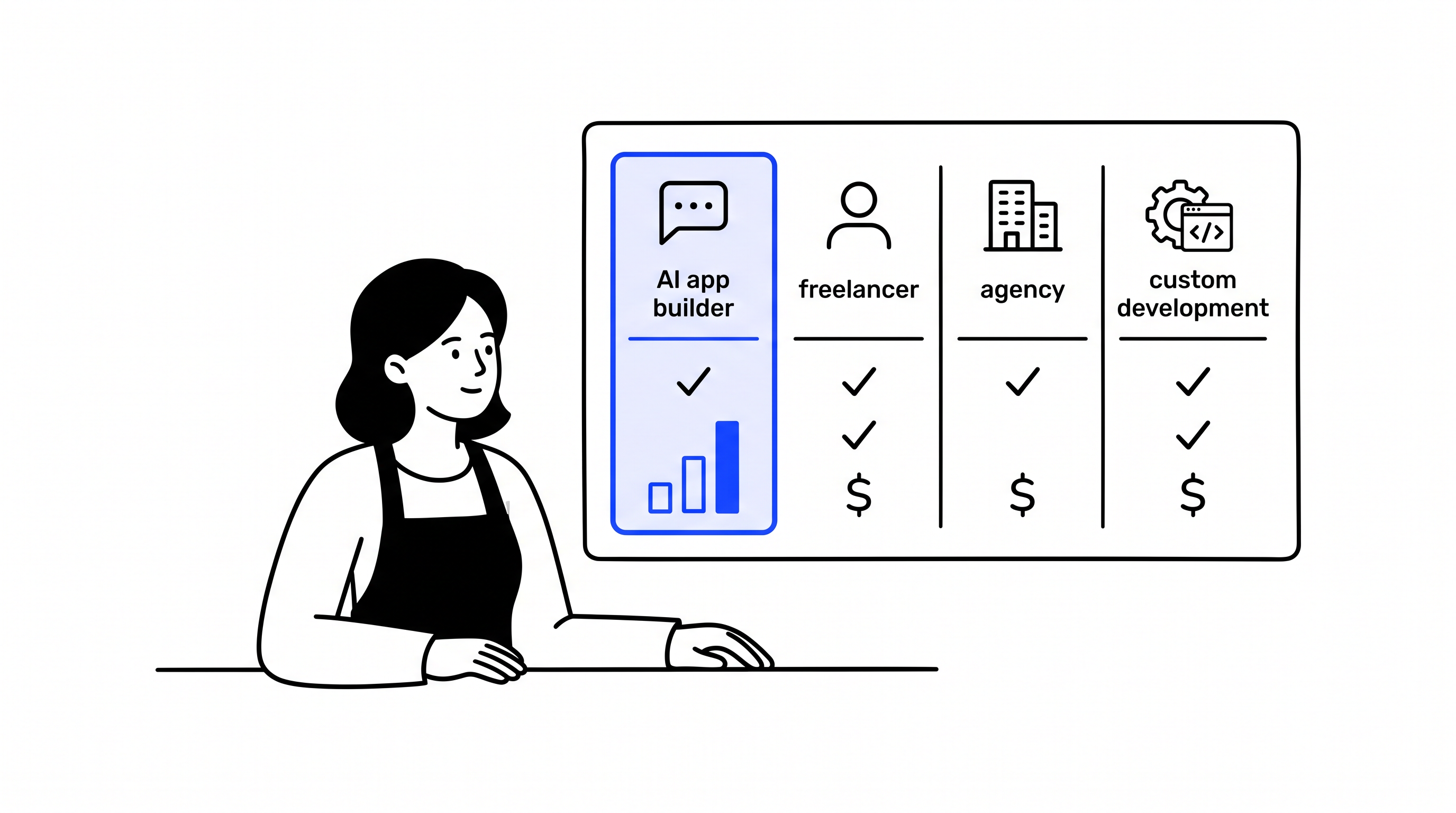
Vibe Business Alternatives for Small Business: The Four Real Options
| Path | Upfront cost | Time to first version | Who maintains it | Biggest risk |
|---|---|---|---|---|
| AI app builder (vibe business) | Low — often a monthly subscription | Hours to days | You, non-technically | Subscription pileup; rebuild risk if you outgrow it |
| Freelancer | Low–medium, hourly or fixed | Days to weeks | The freelancer, until they disappear | Single point of failure — no backup if they go dark |
| Agency | Medium–high | Weeks | The agency, contractually | Higher upfront spend, but continuity is built in |
| Custom development (in-house or contracted) | High, often $50,000+ | Weeks to months | A dedicated developer or team | Slowest path, hardest to justify for one internal tool |
That $50,000-plus figure for traditional custom builds versus "minutes" for AI no-code tools is the exact contrast Mikey No Code lays out in his 2026 breakdown of AI app builders for agencies, SMBs, and entrepreneurs — a useful reality check before you commit budget to any path.
The freelancer-vs-agency-vs-no-code trade-off is not new either. Propulseo's comparison of the three routes lands on the same pattern small businesses keep running into: no-code is the cheapest entry point but risks stacking subscriptions and needing a rebuild once you outgrow it; a freelancer is fast and cheap but is one person, with no backup plan if they stop responding; an agency costs more upfront but gives you continuity you can plan around.

Where Concat.pro Fits Before You Even Pick a Path
Before you choose between these four paths, you need two numbers most small business owners guess at instead of calculate: who else in your space is already winning attention, and whether the tool you are about to pay for will actually pay for itself.
Concat.pro's Rank tool solves the first problem. It surfaces and ranks creators and channels in your niche, so instead of guessing which five accounts to reach out to for a launch push, you get a discovery list ordered by relevance you can act on the same day.
Concat.pro's Margin Calculator solves the second. Point it at your numbers and it models cost against price margin at 10, 50, and 200 customers — so before you sign up for a $49/month AI builder subscription or a $6,000 freelancer invoice, you already know what that spend looks like once you actually scale past a handful of customers, not just on day one.
Run both before you talk to a single vendor. It turns "which option feels right" into "which option pencils out at the customer count we're planning for."
Real Case Study: A Landscaping Business Chose the AI-Builder Path
JT's Landscape Maintenance is a family-owned landscaping company in Waterford Township, Michigan — not a startup, an operating business with crews, trucks, and existing customers. Instead of hiring a developer to build internal software, the team used Jotform's AI App Builder to create a staff collaboration hub for scheduling and job coordination.
The results, reported directly by Jotform: the new hub unlocked roughly $120,000 a year in additional potential revenue by cutting scheduling friction and coordination gaps, and saved the business more than $3,000 a year in costs that used to go toward manual admin work and workarounds. No new hires, no months-long build, no six-figure development contract — a small internal tool, built and maintained by non-technical staff.
This is the case for the AI-builder path when it works: a narrowly scoped internal tool, an owner willing to iterate, and a clear operational bottleneck (in this case, scheduling) that the tool directly targets.

Common Mistakes Small Businesses Make Choosing an Alternative
- Picking the cheapest option without modeling the 50-customer version. A $29/month builder looks free until you are paying for five overlapping subscriptions a year later. Run the Margin Calculator first.
- Hiring a freelancer for something that needs long-term maintenance. Fine for a one-off landing page; risky for a tool your whole staff depends on daily.
- Going straight to custom development for a problem an AI builder already solves. JT's Landscape Maintenance did not need a $50,000 build to fix a scheduling bottleneck.
- Skipping the audience/discovery step entirely. Whatever tool you launch, you still need people to find out about it — run Rank before your launch, not after.
- Never revisiting the decision. The right alternative at 10 customers is not always the right one at 200. Re-run the numbers when you scale.
A Simple Decision Checklist
- Do you have a single, narrowly scoped internal problem (scheduling, intake, reporting)? → AI app builder is worth testing first.
- Does the tool need to survive if one person leaves? → Lean agency over freelancer.
- Have you modeled cost against margin at 10x your current customer count? → Use the Margin Calculator before signing anything.
- Do you know who else in your niche is already getting attention? → Check Rank before launch.
- Is the build genuinely too complex for no-code (deep integrations, compliance, custom data pipelines)? → Custom development, budget for $50,000+.
The Bottom Line
There is no single best alternative — there is a best alternative for your current customer count, your team's technical comfort, and how much operational risk you can absorb. AI app builders won a real, documented case for JT's Landscape Maintenance because the problem was narrow and the owner iterated. Your business might be better served by a freelancer, an agency, or a traditional build. Model the numbers with Concat.pro's Margin Calculator and check your audience with Rank before you spend a dollar on any of them.
For more on building an AI-driven growth stack around whichever path you choose, see Concat Pro's guides on AI tools for small business, small business growth strategies, and the AI-native growth OS.