AI Marketing Agents for Ecommerce: What They Actually Do and Where They Pay Off
Most ecommerce growth teams are stretched across five disconnected tools: a creator-outreach spreadsheet, an ad platform dashboard, an SEO crawler, an email tool, and a reporting deck nobody trusts. Hiring more marketers to stitch it together doesn't scale — headcount grows faster than revenue. That's the gap AI marketing agents are built to close: software that doesn't just draft copy or flag a report, but executes the marketing task end to end — sourcing creators, running and adjusting ad spend, or auditing content for visibility — while a human sets the goal and reviews the output.
This piece breaks down what "AI marketing agent" means in practice, two real ecommerce case studies with hard numbers, a manual-vs-agent comparison, and a rollout plan that avoids the common failure points.
Where Concat Pro Fits as an AI Marketing Agent for Ecommerce
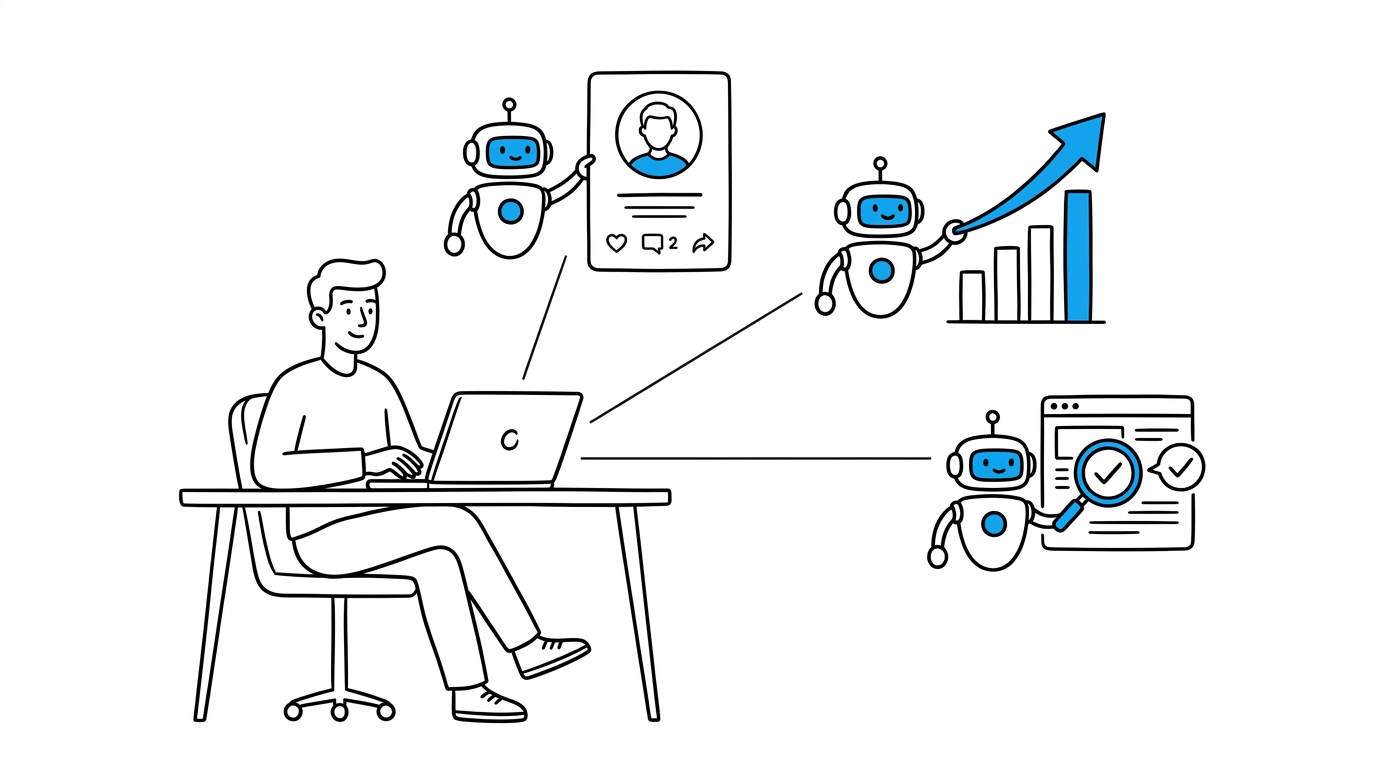
Concat Pro is built around this exact category. Instead of one generalist tool, it runs a set of purpose-built agents that each own a marketing function:
- Creators Agent finds creators aligned with your brand, audience, and growth strategy — replacing the manual scroll-and-DM process most teams still run by hand.
- Ads Agent runs AI-powered influencer ads optimized for performance and growth, reading live campaign data and adjusting spend and creative rather than waiting for a weekly review.
- SEO/GEO Agent audits structured data, heading hierarchy, and schema markup so both traditional search and AI systems like ChatGPT Shopping, Google AI Mode, and Perplexity can parse and cite your product pages.
Where a single agent needs a starting point for outreach, Rank gives you curated leaderboards of top creators and channels by platform and niche — a faster first pass than cold-searching social platforms. And once campaigns are live, the Margin Calculator turns raw spend and revenue numbers into the profit picture that actually decides whether a channel is worth scaling. None of this is a promise of future features — it's what the current product does today, and it's the same logic behind the case studies below: agents that execute, not just report.
Two Ecommerce Brands, Two AI Marketing Agents, Real Numbers
RedBalloon, an Australian experience-gifting marketplace, was paying over AU$45,000 a month to ad agencies and still spending roughly $50 per new customer with no visibility into what the agencies were doing. Co-founder Naomi Simson brought in Albert, an autonomous AI agent that tests ad variations and reallocates budget without waiting for a human sign-off. Within months, RedBalloon cut customer acquisition cost by 25%, lowered total cross-channel marketing cost by 40%, and lifted Facebook conversions by 751%, with some campaigns hitting a 3,434% return on ad spend. Simson fired her agencies and moved her team into an oversight role instead of manual execution.
Crabtree & Evelyn, a global bath-and-body retailer, handed its Facebook paid social program to the same type of agent after years of manually retargeting the same customer segments. In under two months — with media spend flat — return on ad spend rose 30%, reaching 327% ROAS on the channel. The brand's own team said the shift let them focus on the KPI itself instead of the manual work of getting there.
Manual Marketing vs. an AI Marketing Agent
| Task | Manual team | AI marketing agent |
|---|---|---|
| Creator sourcing | Days of searching and DMs per campaign | Continuous, ranked by fit and niche |
| Ad budget reallocation | Weekly or monthly review | Adjusts against live performance data |
| Content/SEO audits | Quarterly, if scheduled at all | Ongoing structured-data and schema checks |
| Reporting | Manually assembled decks | Native to the agent's own execution loop |
A 4-Phase Rollout That Avoids the Common Mistakes
- Audit before you automate. Map which marketing tasks are actually repetitive and data-heavy (creator vetting, bid adjustment) versus strategic. Agents excel at the former.
- Feed it real data first. RedBalloon spent months piloting before fully committing — an agent needs at least a few months of performance history to make good decisions.
- Run one agent, one function, at a time. Point-solution agents are proliferating fast: the tutorial below shows a single-purpose AI agent built just for cart recovery and post-purchase upsells for Shopify stores — useful, but narrow by design.
- Keep a human on strategy, not execution. The team's role shifts from doing the task to setting the goal and reading the results — the same shift RedBalloon and Crabtree & Evelyn both made.
Common mistakes to avoid: handing an agent a channel with no historical data (it has nothing to learn from), running three overlapping automation layers at once and losing the ability to tell what's driving results, and treating "AI agent" as a one-time setup instead of an ongoing feedback loop between the agent, your team, and your margin numbers.
For a concrete look at how narrow, single-purpose AI agents are already automating parts of the ecommerce funnel, watch Best Shopify AI Agent for Ecommerce Stores in 2026 below — a walkthrough of an agent built specifically for checkout recovery and post-purchase upsells, the same execution logic that broader marketing agents apply to creator, ad, and content work.
Getting Started Without Overcommitting
Start with the function draining the most manual hours — usually creator outreach or ad budget management — and measure the before/after with a real number like CAC or ROAS, not a vague "efficiency" claim. For more on sourcing creators and running paid social with AI, see Concat Pro's guides on AI advertising for ecommerce and AI content marketing for ecommerce, and the broader landscape in AI marketing tools for commerce.
The brands seeing real ROAS and CAC gains from AI marketing agents picked one function, fed it real data, and let their team move up to strategy while the agent handled execution.