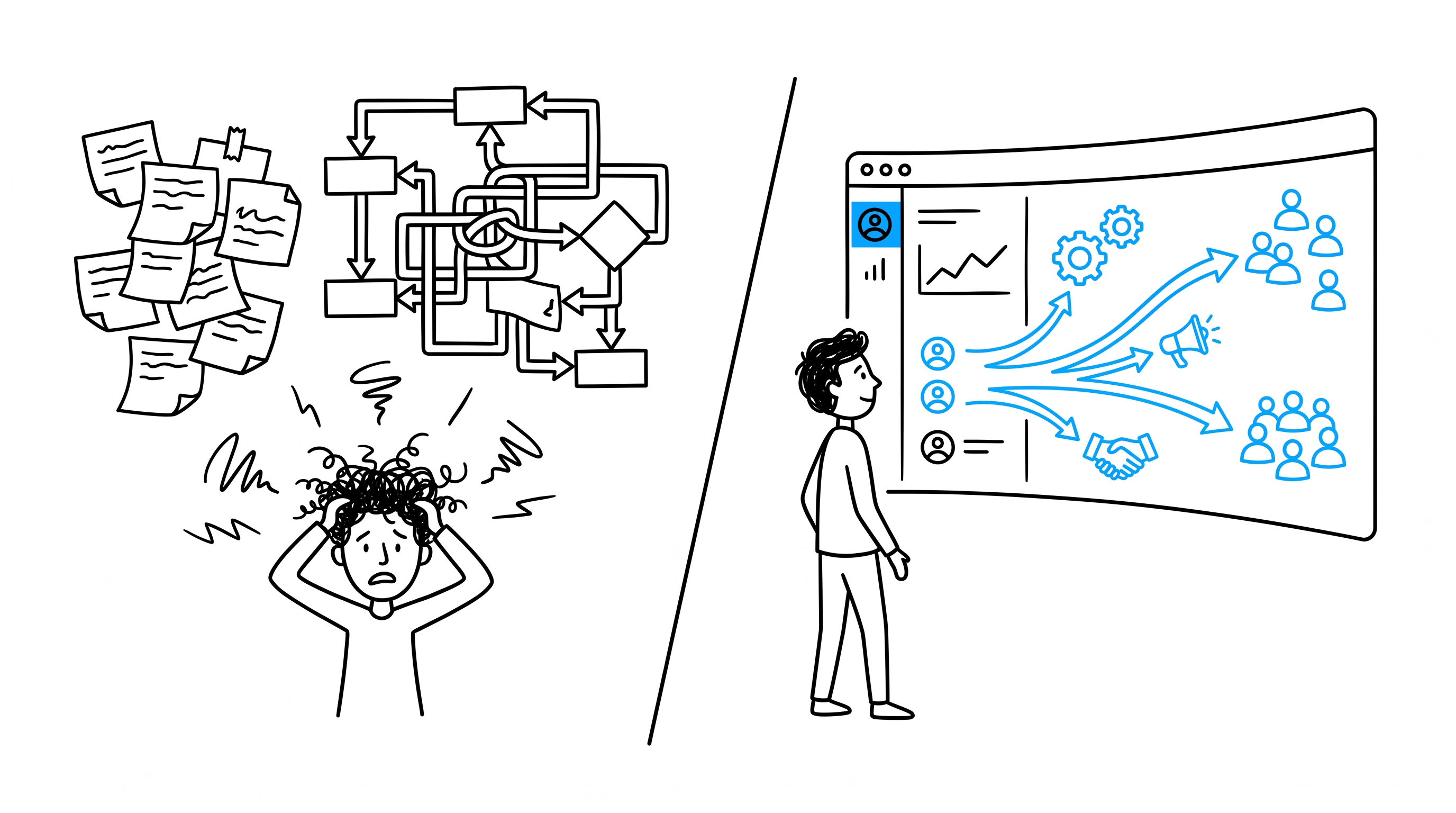
Most ecommerce teams already run "automation." A welcome series, an abandoned-cart email, maybe a winback flow. The problem isn't that these flows don't exist — it's that they're built on fixed if-this-then-that logic, and customer behavior isn't fixed. A shopper who opens five emails and buys nothing gets the same generic nudge as one who's three clicks from checkout. Static rules can't tell the difference, and every hour a growth team spends manually re-segmenting lists or guessing send times is an hour not spent on the decisions that actually move revenue.
AI marketing automation changes what the system decides, not just what it sends. Instead of a human setting one rule for one segment, machine-learning models score intent, pick the message, and choose the send time per individual shopper — then adjust as new behavior comes in. That's the gap between a flow that "runs" and a flow that "learns."
Where Concat Pro Fits Into AI Marketing Automation for Ecommerce
Before adding another automation platform, most teams need two things: a realistic view of where their brand already stands, and a way to turn a lift number into an actual revenue projection. That's the part of the stack Concat Pro covers today.
Rank surfaces the top creators and channels across platforms and industries, which matters the moment your AI automation program adds an influencer or affiliate layer to feed fresh top-of-funnel traffic into those newly personalized flows — you need a starting list of who's already active in your category before you brief anyone. And when a vendor pitches a lift number, don't take it on faith. Feed it into the Growth Rate Calculator: enter your current conversion rate as the start value, the promised post-AI rate as the end value, and it returns the compound growth rate so you can size the actual dollar impact before you sign a contract, not after.
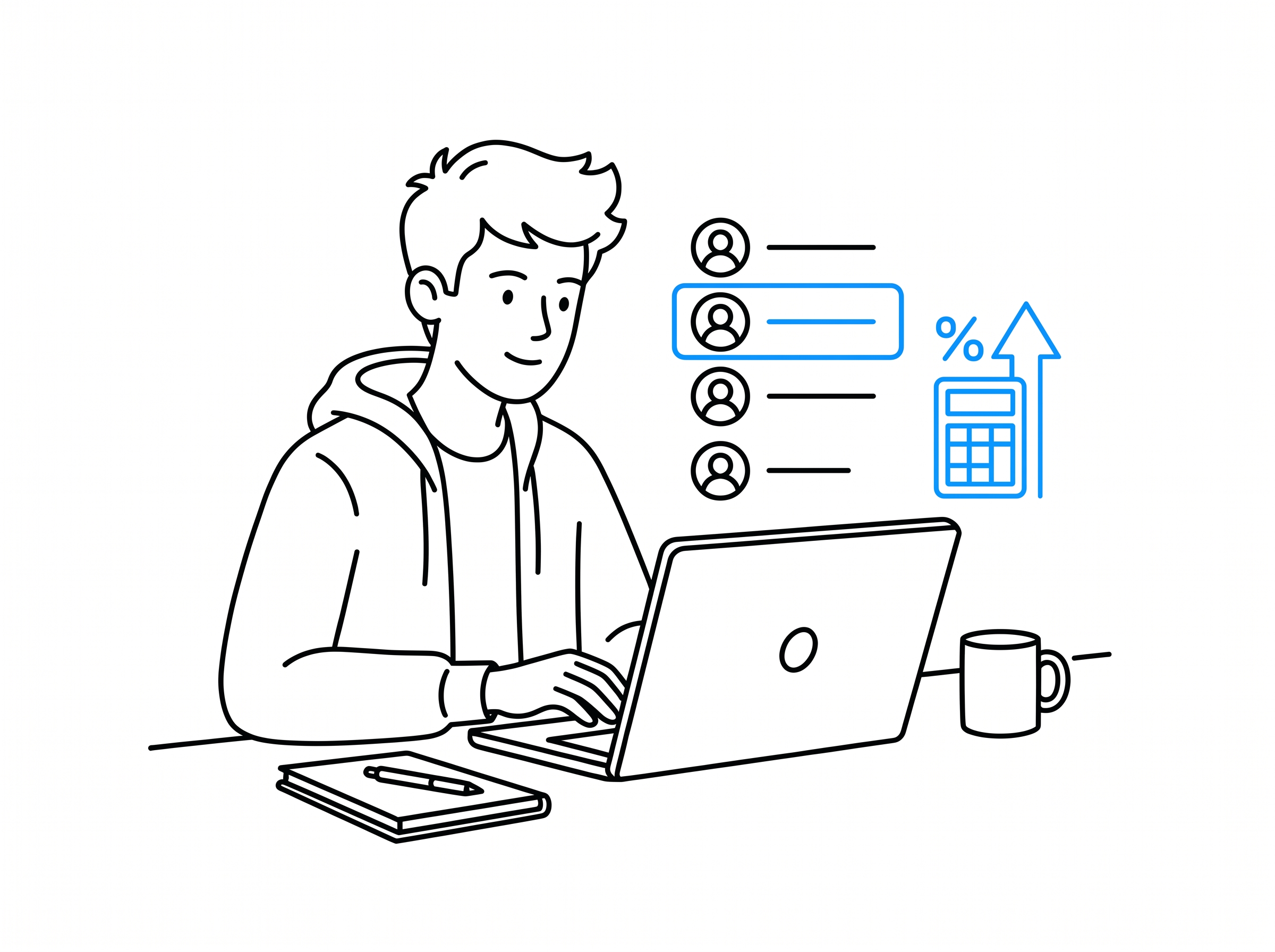
Concrete scenario: a four-person DTC skincare brand is quoted a "2.4x conversion lift" from an AI campaign vendor. Instead of accepting the multiple at face value, the team runs their current 1.44% conversion rate and the promised 3.45% through the Growth Rate Calculator, confirms the implied lift matches the vendor's claim, and models it against their actual monthly order volume — turning a vague multiplier into a specific revenue forecast before committing budget.
For the segmentation and creative-testing side of this workflow, see how other teams structure it in AI Personalization in Ecommerce and AI Analytics for Ecommerce; for retention-specific flows, AI for Ecommerce Customer Retention covers the winback and loyalty side of the same stack.
Manual Automation vs. AI Marketing Automation
| Dimension | Manual / Rule-Based | AI Marketing Automation |
|---|---|---|
| Trigger | Fixed event, same response every time | Behavioral signal, weighted by predicted intent |
| Segmentation | Static lists, rebuilt manually | Dynamic, updates as behavior changes |
| Send timing | One scheduled time for all | Per-subscriber optimal time |
| Targeting scope | Often sent to the full list | Sent only to the highest-intent segment |
| Optimization | A/B test, manual review | Continuous, model adjusts automatically |
Real Growth Cases
24S × Braze. The LVMH-owned luxury retailer replaced three separate systems (triggered email, mobile messaging, recommendations) with one AI-driven setup combining BrazeAI item recommendations and behavior-triggered Canvas journeys. An abandoned-cart campaign with low-stock urgency messaging drove a 35% increase in 3-day purchase conversion over six months. A second campaign, recommending back-in-stock items based on browsing behavior, lifted add-to-cart rate by 7% — and the team built it in a few hours, not weeks. (Braze case study)
260 Sample Sale × Bloomreach. This 400-brand, multi-vendor flash-sale retailer used agentic AI (Bloomreach's Loomi) to automate weekly "Last Chance" emails and cart-recovery flows across a 900K-contact list, replacing roughly 35 hours a week of manual segmentation. The AI-run campaign converted at 3.45% versus 1.44% for the manual baseline — a 2.4x lift — while emailing only 18% of the list, the highest-intent 36,000 contacts. That single campaign generated an incremental $10,000, the abandoned-cart flow added $12,000 in 30 days, and across four automated scenarios the brand attributed over $580,000 in total AI-influenced revenue. (Bloomreach case study)
The pattern in both: the win came from targeting fewer people better, not blasting more people faster.
Common Mistakes
- Automating a broken flow. If your manual abandoned-cart email already converts poorly, AI just fails faster and more expensively.
- Sending to the whole list because you can. 260 Sample Sale's best result came from sending to 18% of contacts, not 100%.
- Skipping the before/after baseline. Without your current conversion rate on record, you can't prove the AI lift is real versus seasonal noise.
- Treating vendor multipliers as guaranteed. A "2.4x" or "35%" claim needs to be run against your own numbers before you budget around it.
- Consolidating tools before fixing data. 24S's win came after unifying three systems into one clean data source — sequence matters.
Watch: The AI Trends Reshaping Marketing Automation in 2026
For a broader view of where this is all heading — autonomous AI agents, MCP-connected tools, and campaign optimization that runs without a human clicking every button — this recent explainer is a useful primer: